Evidence Check · Castor oil
Castor oil for brows and lashes: does it thicken anything?
The castor-oil-for-lashes story is mostly anecdote and small preclinical work; systematic reviews find no strong human evidence for hair growth, while product formulations sometimes hide stronger, drug-like ingredients that do have effects and safety concerns.
Castor oil is one of the most frequently recommended home remedies for thicker brows and longer lashes. The idea is simple: rub a little oil where hair grows, and over time the hair will look fuller. That claim, as it stands, rests largely on tradition, product marketing and a handful of laboratory or animal experiments—not on good human trials of castor oil applied to eyelashes or brows.
Systematic and narrative reviews of common hair oils conclude there is no strong clinical evidence that castor oil increases hair growth in humans; the clinical signal for castor oil is weaker than for some other oils and largely limited to anecdote or low-quality studies, according to the reviews.1,2
there is no strong clinical evidence that castor oil increases hair growth in humans;
Where the lash claim comes from
There are three idea streams behind the castor-oil-for-lashes claim: folk use and cosmetically driven tradition, small laboratory or animal studies of castor oil or its major constituent ricinoleic acid, and confusion with eyelash serums that actually contain prostaglandin analogues. The latter are druglike compounds that are known to lengthen lashes and are present in many over‑the‑counter serums, not always clearly labelled as regulated actives.3,4
A 2026 market study of eyelash serums found that about 30% of products promising longer or fuller eyelashes contained prostaglandin analogues such as bimatoprost and other related compounds, while other products were formulated with ingredients like castor oil, peptides and panthenol. The study noted a regulatory issue because prostaglandin analogues are being used in cosmetic products without the controls such compounds typically require.3
Separately, computational work has flagged ricinoleic acid—the main fatty acid in castor oil—as a candidate inhibitor of prostaglandin D2 synthase, a pathway of interest in androgenetic hair loss. That in silico finding suggests a plausible biochemical route worth testing, but it is only a computer prediction and not evidence that applying castor oil to lashes will stimulate growth.4
Evidence on growth: lab dishes, mice and a few human trials that don’t isolate castor oil
Human evidence specifically testing plain castor oil on eyelashes is, to be blunt, missing. There are no controlled trials in humans of castor oil applied to lashes or brows that demonstrate increased hair growth.1,2
Animal data are thin and inconsistent. In a small murine study that included groups treated with rosemary oil, castor oil, a 1:1 rosemary–castor combination, minoxidil and untreated control, the castor oil–alone group had shorter mean hair length than the combination and than topical minoxidil; the combination trended closer to minoxidil. The study was tiny and intended as pilot work, so its results are suggestive at best.5
There is at least one randomized, double‑blind clinical trial that included a rosemary–castor oil formulation for scalp hair over 90 days, but that study tested a blended topical product for scalp hair and did not isolate plain castor oil on eyelashes. Because blends mix active botanical components, they do not tell us what castor oil alone would do for brows or lashes.6
Systematic reviewers conclude that, across the available literature, castor oil lacks convincing clinical evidence for hair growth. Reviews note better evidence for other oils in specific uses (for example, coconut oil for hair breakage) and call for more rigorous human trials specifically assessing castor oil’s effects on hair growth.1,2
Why castor oil can make lashes look fuller without growing them
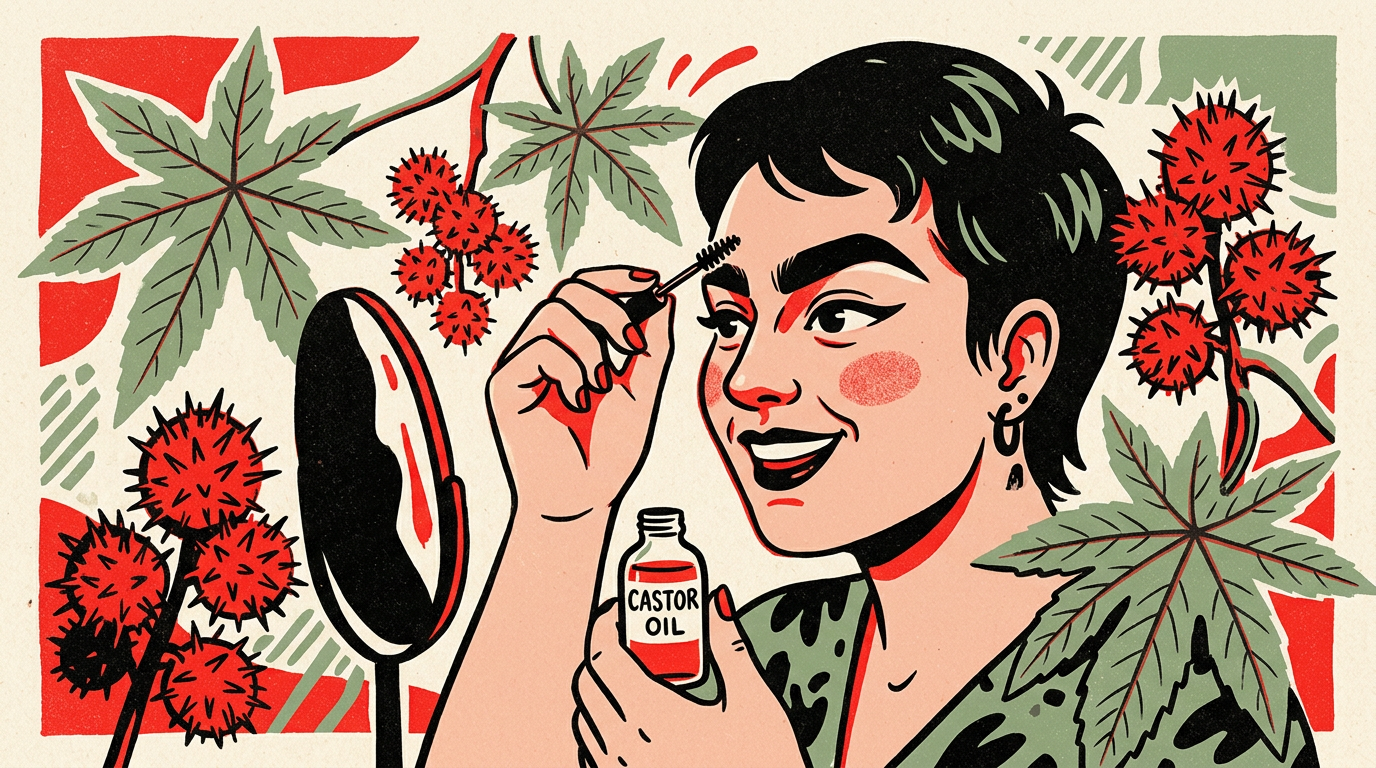
Oils change appearance. A coat of oil can darken hairs, make them lie together rather than splay apart, and reduce static; that can make a lash line look denser even when no new hairs have grown. These are cosmetic, temporary effects of coating and grouping existing hairs rather than evidence of true follicular stimulation.
A coat of oil can darken hairs, make them lie together rather than splay apart
Because much of the castor‑oil claim rests on visual improvement rather than measured increases in hair count or follicle activity, before‑and‑after photos and anecdote can be misleading unless a study actually counts hairs or measures anagen/telogen ratios under controlled conditions.1
Safety near the eye — irritation, product formulation and regulatory cautions

Applying anything near the eye carries risks that are different from applying it to the scalp. Oils can trap debris on the lid margin, and unclean applicators or contaminated jars can introduce bacteria. That said, a small randomized paired‑eye trial of 100% cold‑pressed castor oil applied to the eyelids twice daily for four weeks in people with blepharitis reported improvements in symptoms and several clinical signs confined to treated eyes, suggesting castor oil can be tolerated and may even help eyelid inflammation in that patient group.7
Products sold as cosmetic lash serums are not all the same. The market survey found that many eyelash serums contain prostaglandin analogues—potent, drug‑class substances—while others rely on benign ingredients such as castor oil. The presence of prostaglandin analogues in unregulated cosmetic formulations raises safety and labeling concerns; consumers may think they are buying a simple oil when in fact they are using a pharmacologically active compound.3
Computer predictions of ricinoleic acid’s safety profile were not alarming in the in silico work cited, but computational tolerability is not a substitute for clinical safety data around the eye. Because the eyelid and ocular surface are sensitive, formulations intended for periocular use deserve careful testing and preservative systems that prevent microbial contamination.4,7
Bottom line for practitioners and people curious about fuller brows or lashes
If the question is strictly “Does applying castor oil to lashes or brows make more hairs grow?” the honest answer is: there is no good human evidence that plain castor oil increases lash or brow growth. Systematic and narrative reviews find no strong clinical support, and the animal data are small and inconclusive.1,2,5
Castor oil may improve the cosmetic appearance of lashes by coating and darkening hairs, and small clinical work suggests topical castor oil can be tolerated on eyelids and might help lid inflammation in people with blepharitis. But these findings are not the same as demonstrating new hair growth.1,7
If a consumer wants a treatment with established lash‑growth effects, many lash products on the market that claim growth actually contain prostaglandin analogues—compounds identified in a market survey—not plain castor oil. Those compounds are pharmacologically active and raise different regulatory and safety questions than an oil rubbed on hair shafts.3
For clinicians: when patients ask, be explicit about what the evidence does and does not show. Plain castor oil has cultural and cosmetic utility and may improve the look of lashes, but it is not supported by controlled human trials as a lash‑growth agent. If a patient has eyelid inflammation, the small randomized trial suggests periocular castor oil can be beneficial, but generalizing that result to cosmetic lash use requires caution.1,2,7
Research note: the chemistry of ricinoleic acid makes it an interesting candidate for further study—computational work flagged it against an enzyme implicated in hair loss—but that is hypothesis generation, not proof. Adequately powered, controlled human trials that test plain castor oil applied to eyelashes and brows are the evidence gap to be filled.4
In the Botanical Index
Sources
- Coconut, Castor, and Argan Oil for Hair in Skin of Color Patients: A Systematic Review. — Phong C, Lee V, Yale K, Sung C, Mesinkovska N. · Journal of drugs in dermatology : JDD · 2022
- Commonly used hair oils in the Black community: a narrative review in their use to treat androgenetic alopecia. — Dinkins J, Iwuala C, Akintilo L, Ugonabo N, Shapiro J, Sicco KL, Adotama P. · International journal of dermatology · 2023
- Prostaglandin analogues in cosmetic products formulated for eyelash lengthening. — Couteau C, Coiffard L. · Annales pharmaceutiques francaises · 2026
- In silico prediction of prostaglandin D2 synthase inhibitors from herbal constituents for the treatment of hair loss. — Fong P, Tong HH, Ng KH, Lao CK, Chong CI, Chao CM. · Journal of ethnopharmacology · 2015
- An Exploratory Preclinical In Vivo Pilot Study Evaluating the Hair Growth-Promoting Effects of Rosmarinus officinalis and Ricinus communis Combination. — Mathenge A, Odongo E, Mauti R, Osee F. · BioMed research international · 2026
- Rosmagain™ as a Natural Therapeutic for Hair Regrowth and Scalp Health: A Double-Blind, Randomized, Three-Armed, Placebo-Controlled Clinical Trial. — Patel MN, Tuli N, Patel N, Merja A. · Cureus · 2025
- Randomized trial of topical periocular castor oil treatment for blepharitis. — Muntz A, Sandford E, Claassen M, Curd L, Jackson AK, Watters G, Wang MTM, Craig JP. · The ocular surface · 2021
Discussion
0 commentsShare experiences, questions and sources. Be kind, and please don't give medical advice. Comments are checked before they appear, and anything that reads like a treatment claim goes to our editors first.
Join the conversation
A free reader account lets you comment and reply to other readers.
No comments yet. Start the discussion.