Botanical Index / everything about
Argan
Morocco’s liquid gold for soft skin and shinier strands
Argania spinosa
The short version
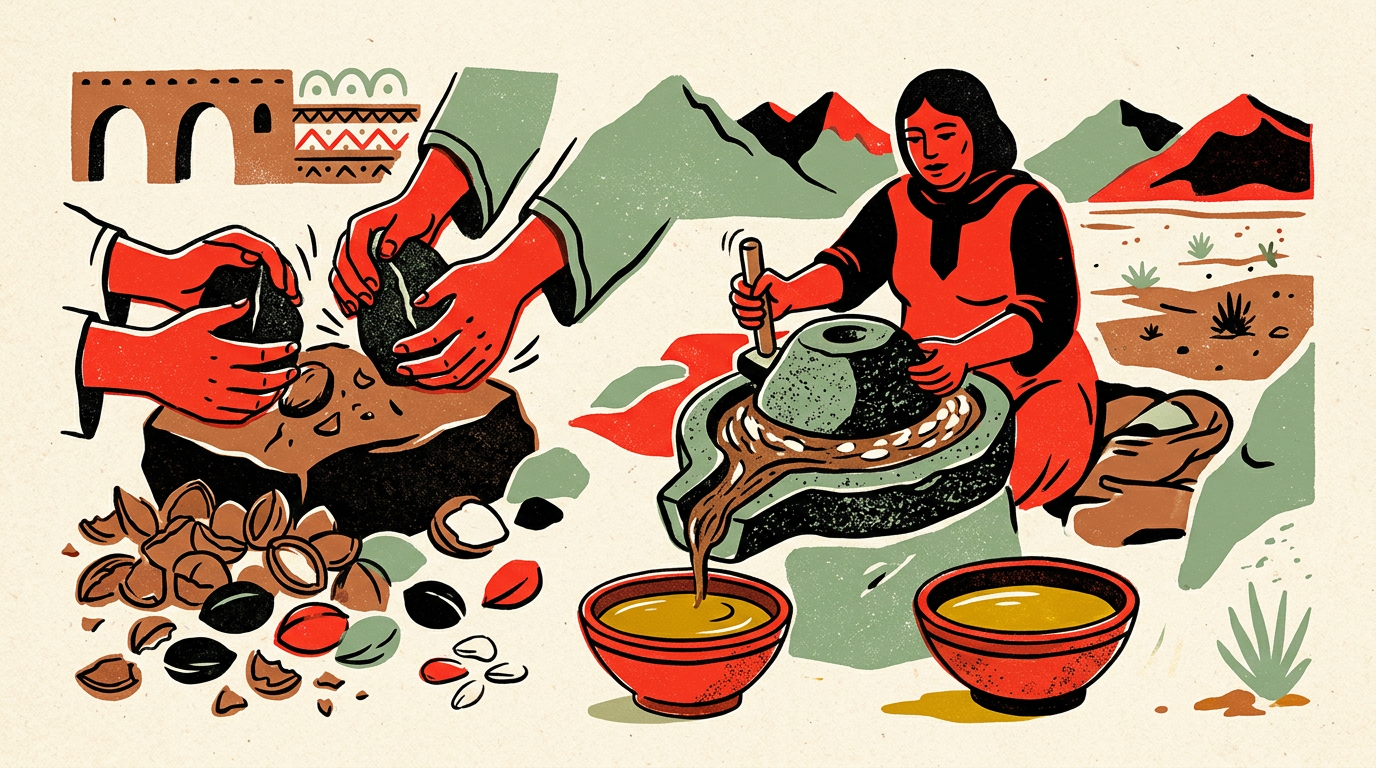
Argan oil is pressed from the kernels of the Moroccan argan tree. People use it on skin and hair because it’s a light, stable oil that softens, smooths and adds shine. It also plays nicely as a carrier oil in creams and serums.
- Family
- Sapotaceae
- Part used
- Kernel (pressed oil)
- Comes from
- South-west Morocco
Good for?
Used as an emollient for dry or rough skin and as a finishing oil for hair. It coats the surface, reducing micro‑roughness and friction, which helps hair look smoother and glossier. Chemically, it is rich in oleic and linoleic acids and contains tocopherols, giving a pleasant spread and good oxidative stability. Formulators also use it as the oil phase to solubilize or carry other ingredients in gels and creams.
Does it actually work?
Real trials.
Controlled trials on people back it up.
Evidence grade 4 out of 5.
“Analytical work and reviews consistently report a high oleic/linoleic profile and measurable tocopherols and phenolics, supporting use as a stable, skin‑friendly emollient.”
What the studies say
Analytical work and reviews consistently report a high oleic/linoleic profile and measurable tocopherols and phenolics, supporting use as a stable, skin‑friendly emollient. A small split‑face randomized controlled trial tested a cream that included argan oil alongside other moisturizers after fractional CO2 laser and found benefits versus placebo, but the blend prevents crediting argan oil alone. Several formulation and delivery studies use argan oil as the lipid phase, showing suitable stability, solubilization of actives, and in vitro or ex vivo skin/hair penetration. Cell studies on argan press‑cake or callus extracts suggest antioxidant and anti‑inflammatory activity, though these materials differ from the plain oil. Overall: good plausibility and supportive lab work, but few controlled trials isolating pure argan oil for common skin or hair endpoints.

What's inside
- ~42–50% of fatty acidsOleic acid (C18:1)One of the two dominant unsaturated fatty acids.
- ~29–37% of fatty acidsLinoleic acid (C18:2)Co‑dominant; contributes to light feel.
- ~12–15% of fatty acidsPalmitic acid (C16:0)Main saturated fraction.
- ~5–7% of fatty acidsStearic acid (C18:0)Minor saturated component.
- ~400–900 mg/kg totalTocopherols (mostly γ‑tocopherol)Antioxidant fraction linked to oil stability.
- ~1–2 g/kgSterols (spinasterol, schottenol)Characteristic phytosterol profile of argan oil.
Read this first
Topical uses reported in the cited studies were generally well tolerated; in vitro keratinocyte assays of argan‑oil oleogels and nanoemulsions did not show concerning cytotoxicity. As with any new oil, patch test first if your skin is reactive or highly sensitive.
The stories
2 in the JournalIndex Explainer · Beard
Beard oils: what’s actually in them and what they do
Beard oils are mostly light carrier oils (jojoba, argan, sometimes castor) plus fragrance; as topical emollients they soften coarse facial hair and can reduce skin inflammation and itch, but there’s little direct human evidence that they make beards thicker or grow faster. (Evidence for moisturising and anti-inflammatory effects comes mainly from lab, animal and formulation studies.)
- Hair
Myth Busting · Argan
Argan oil for frizz: shine, not repair
Argan oil’s value for frizz is primarily cosmetic: its fatty acids and surface‑active lipids coat the hair, smooth the cuticle and add shine. The literature here shows compositional differences, processing effects, and antioxidant activity — useful context for styling — but not clinical proof that oil restores broken ends or structurally repairs hair.
- Hair
Reviewed
Sources
- Efficacy and safety of combination cream of stimu-tex AS™ (spent grain wax, Argania Spinosa Kernel oil, Butyrospermum Parkii (shea butter) extract), and saccharide isomerate after fractional CO2 laser procedure: split-face, double blinded, randomized controlled trial. — Sitohang IBS, Arimuko A, Norawati L, Maria R, Yulyana C, Nugraha RS, Amanda V, Indrafatina A, Amalia I. · Lasers in medical science · 2025
- Ethnopharmacological Knowledge and Antioxidant Propensities of Argania spinosa L. from Morocco. — El Yamani M, Ijjouk R, Kahime K, Rharrabti Y. · Advances in pharmacological and pharmaceutical sciences · 2024
- Grape Pomace Extract-Loaded Liposomes Enriched Cream Formulations for Skincare. — Radulescu C, Olteanu RL, Pavaloiu RD, Sha'at F, Stanciu G, Tudorache MN. · Antioxidants (Basel, Switzerland) · 2026
- Encapsulation of Cannabidiol in Chitosan-Stabilized Argan Oil Nanoemulsion as a Potential Dermal Drug Delivery System for Psoriasis Treatment. — Mdarhri Y, de-Monte-Vidal V, de-Almeida-Perez-Pimenta C, Cuello-Rodríguez S, Touhami A, Touhami F, Chabbi M, Díaz-Tomé V. · Pharmaceutics · 2026
- Development and characterization of dibenzalacetone-loaded oleogels as a potential photoprotective agents for sunscreen formulations. — Sheta NM, Taher AT, Rashwan KO, Mahmoud AM, Abuelella KE. · Scientific reports · 2026
- Photobiomodulation as a strategy to enhance argan oil permeation across diverse hair types. — Susigan BF, André LP, Lyra LF, Sakane KK, Pinto JG, Ferreira-Strixino J. · Spectrochimica acta. Part A, Molecular and biomolecular spectroscopy · 2025
- Ethnobotany, traditional knowledge, and nutritional value of Argan (Argania spinosa (L.) Skeels) in Western Anti-Atlas of Morocco. — Barkaoui M, Msanda F, Boubaker H, El-Boullani R, Asri OE, Chokri A, El-Yaagoubi M, Koutaya A, Eloirdi A, Arifi K, Chahboune M. · Brazilian journal of biology = Revista brasleira de biologia · 2022
- Ethnobotany, phytochemistry and biological properties of Argan tree (Argania spinosa (L.) Skeels) (Sapotaceae) - A review. — Mechqoq H, El Yaagoubi M, El Hamdaoui A, Momchilova S, Guedes da Silva Almeida JR, Msanda F, El Aouad N. · Journal of ethnopharmacology · 2021
- A Comprehensive Review of Plant-Based Cosmetic Oils (Virgin Coconut Oil, Olive Oil, Argan Oil, and Jojoba Oil): Chemical and Biological Properties and Their Cosmeceutical Applications. — Abdalla S, Aroua MK, Gew LT. · ACS omega · 2024
- Domesticated Argania spinosa in Eastern Morocco: HPLC-DAD/GC-MS Chemical Profiling, Antioxidant and Antidiabetic Activities, and Network Pharmacology-Guided Molecular Docking. — Azizi SE, Daoudi NE, Roubi M, Alami Merrouni I, Hendrawan AF, Bnouham M, Berrichi A, Dalli M, Legssyer B, Gseyra N. · International journal of molecular sciences · 2026
- Comparative Study of the Physicochemical Properties and Nutritional Quality of Argan Oil from Endemic and Planted Argania spinosa (L.) Fruit Trees in South-West Algeria. — Ould Safi M, Di Bella G, Nava V, Albergamo A, Bencheikh A, Boudeffeur S, Boughalia M, Kechairi R, Potortì AG. · Foods (Basel, Switzerland) · 2026
- Argan Oil: A Natural Bioactive Lipid Modulating Oxidative Stress and Inflammation. — Rabbaa S, Bouchab H, Laaziouez Y, Limami Y, Nasser B, Andreoletti P, Cherkaoui-Malki M, El Kebbaj R. · Antioxidants (Basel, Switzerland) · 2025
- Exploring the Impact of Extraction Methods on the Nutritional and Sensory Profiles of Argan Oil from Mostaganem Kernels. — Aridj T, Boukezzoula N, Tefiani C, Benabdelmoumene D, Chaalel A, Berrahal N, Tahlaiti A, Bentounes A, Różański H, Szumny A. · Foods (Basel, Switzerland) · 2026
- Effects of physical refining process on quality and stability of argan oil (Argania Spinosa (L.) Skeels). — Asbbane A, Bousaid Z, Guillaume D, El Harkaoui S, Matthäus B, Charrouf Z, Goh KW, Srasom N, Bouayahya A, Gharby S. · Scientific reports · 2024
- Green enrichment of argan oil (Argania spinosa L.) with thyme (Thymus vulgaris L.) and oregano (Origanum vulgare L.) leaves: Evaluating quality and stability improvements. — Oubannin S, Asbbane A, Goh KW, Singh J, Zafar I, Bouyahya A, Gharby S. · Food chemistry: X · 2024
- Ultrasound-assisted enrichment of argan oil (Argania spinosa L.) with thyme (Thymus vulgaris L), oregano (Origanum vulgare L.) and saffron (Crocus sativus L.) powders: Impact on bioactive compounds and oxidative stability. — Oubannin S, Asbbane A, Hallouch O, Nouj N, Goh KW, Bouyahya A, Gharby S. · Ultrasonics sonochemistry · 2025