Botanical Index / everything about
Shea
Plant butter that locks in bath-time moisture.
Vitellaria paradoxa
The short version
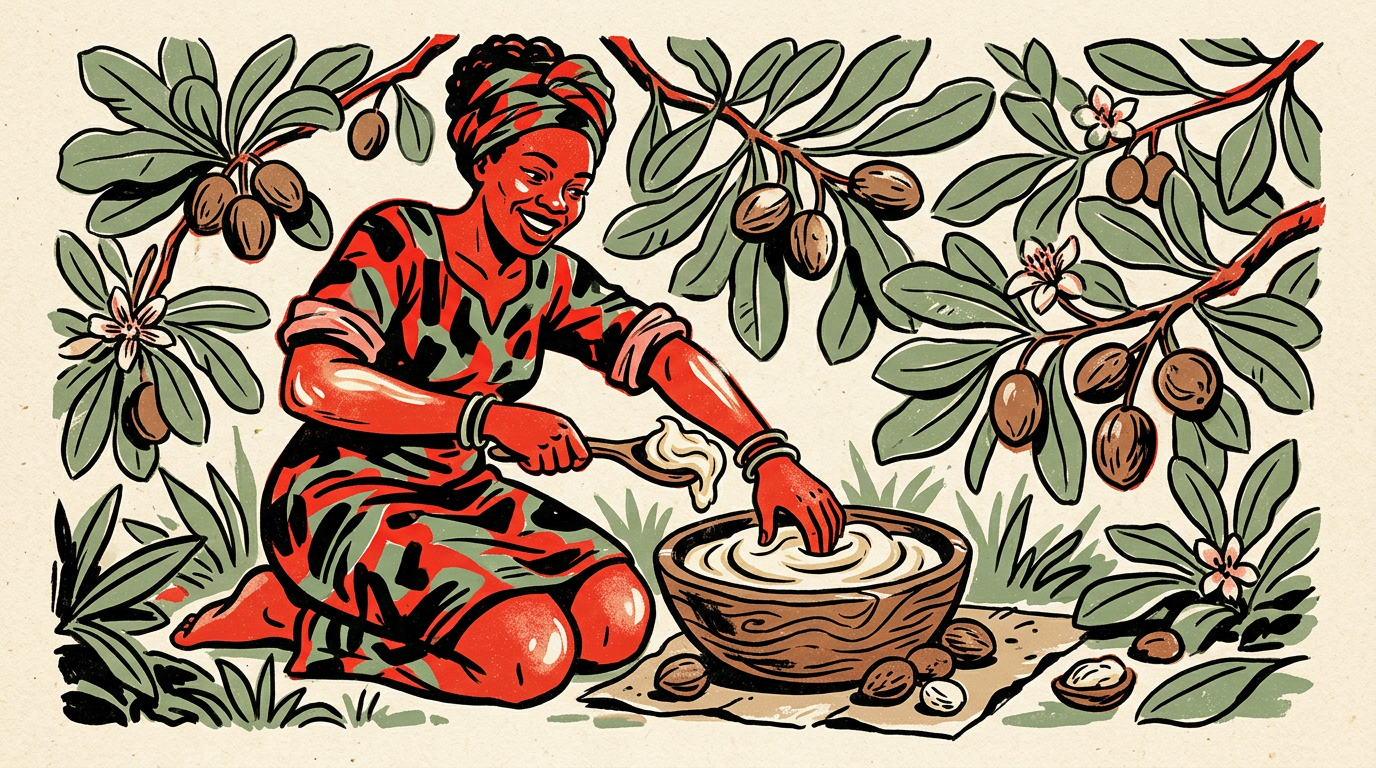
Shea butter is the fat from shea tree nuts, widely used across Africa. People put it on dry skin because it softens and forms a comfy film that slows water loss.
- Family
- Sapotaceae
- Part used
- Nut (butter)
- Comes from
- The savanna belt of West and Central Africa
Good for?
Used as a rich emollient and occlusive for dry body skin. Most clinical products that include shea also contain humectants and other emollients, and these combinations improve hydration and reduce irritation. A diaper delivering a shea‑based emollient reduced redness versus a no‑emollient diaper. Applying after bathing can help trap existing water; this fits its occlusive role, though head‑to‑head timing tests were not part of these studies.
Does it actually work?
Real trials.
Controlled trials on people back it up.
Evidence grade 4 out of 5.
“The best evidence comes from controlled trials of multi‑ingredient moisturizers that include shea, rather than shea alone.”
What the studies say
The best evidence comes from controlled trials of multi‑ingredient moisturizers that include shea, rather than shea alone. In a randomized crossover diaper study, an anhydrous shea‑based emollient helped keep baby skin less red than a no‑emollient diaper and performed similarly to a petrolatum comparator in adult forearm models. A split‑face randomized trial after fractional CO2 laser found a combination cream containing a shea extract improved early barrier and hydration measures versus placebo. Lab and pilot work on isolated shea triterpenes, plus animal burn models, suggest possible wound‑related activity, but these do not establish outcomes for plain shea butter in humans.

What's inside
- Minor triterpene fraction; percentages varyLupeolIdentified in shea; studied for wound‑related effects in lab and early clinical contexts.
- Minor triterpene fraction; percentages varyAlpha‑amyrinIdentified in shea; explored for regenerative roles in preclinical and small clinical work.
- Minor triterpene fraction; percentages varyBeta‑amyrinIdentified in shea; part of the unsaponifiable portion linked to bioactivity.
Read this first
An expert safety panel concluded shea‑derived cosmetic ingredients are safe as used when formulated to be non‑sensitizing. They advise good manufacturing to limit impurities and to consider cumulative botanicals with similar constituents. Very sensitive users may prefer a small patch test with new products.
Reviewed by the Expert Panel for Cosmetic Ingredient Safety; concluded safe in current uses and concentrations when formulated to be non‑sensitizing. INCI listings commonly use Butyrospermum parkii for shea‑derived ingredients.
The stories
2 in the JournalMyth Busting · Body care
Body oil vs. lotion: which works better on damp skin
Oils don’t add water; they mainly block water loss. Moisturizers that work combine water-adding humectants with emollients and an occlusive. Clinical studies repeatedly show emollient-containing lotions or creams help dry or eczematous skin, but direct trials pitting a plain oil against a lotion applied to damp skin are sparse in this set of abstracts.
- Body
Index Explainer · Shea
Shea butter: why it works for dry skin
Shea butter works mainly as an occlusive lipid-rich butter with some minor bioactive components; clinical studies in babies and children and several small trials of mixed creams support its role as an effective emollient, but many trials test blends rather than shea alone.
- Skin
- Body
Reviewed
Sources
- Ethnopharmacological evaluation of Vitellaria paradoxa triterpenes for wound healing: In vivo evidence of lupeol and α/β-amyrin in promoting dermal regeneration. — Anyanwu EG, Onuchukwu CL, Ojukwu CP, Anyanwu CN. · Journal of ethnopharmacology · 2026
- Vegetable Butter-Based Nanocarriers: Do Nanoparticulation and Quercetin Loading Modulate In vitro Cellular Effects Involved in Wound Healing? — Costa ABC, Daré RG, Lopes LB. · AAPS PharmSciTech · 2026
- Efficacy and safety of combination cream of stimu-tex AS™ (spent grain wax, Argania Spinosa Kernel oil, Butyrospermum Parkii (shea butter) extract), and saccharide isomerate after fractional CO2 laser procedure: split-face, double blinded, randomized controlled trial. — Sitohang IBS, Arimuko A, Norawati L, Maria R, Yulyana C, Nugraha RS, Amanda V, Indrafatina A, Amalia I. · Lasers in medical science · 2025
- Experimental study comparing burn healing effects of raw South African Shea butter and the samples from a Libyan market. — Treesh SA, Saadawi SS, Alennabi KA, Aburawi SM, Lotfi K, Ben Musa AS. · Open veterinary journal · 2021
- Clinical Evaluation of a Diaper Containing a Shea Butter-Based Emollient and Impact on Diapered Skin Erythema. — O'Connor RJ, Visscher MO, Narendran V, Wang Y, Wiesemann F, Carr AN. · Pediatric dermatology · 2025
- Accessibility and affordability of emollients in the management of atopic dermatitis in Africa. — Otrofanowei E, Ahogo CK, Atadokpede F, Bahloul E, Cole-Adeife O, Dlova N, Doni SN, Faye O, Ibekwe PU, Kayitenkore K, Kebe M, Kombo Bayonne ES, Kouotou EA, Ly F, Mavura D, Nkosiyenzile C, Ouédraogo AN, Rakotonandrasana F, Fandresena S, Seudjip Nono LJ, Turki H, Ogu C, Rapelanoro Rabenja F. · The Journal of investigative dermatology · 2026
- Safety Assessment of Butyrospermum parkii (Shea)-Derived Ingredients as Used in Cosmetics. — Burnett CL, Bergfeld WF, Belsito DV, Hill RA, Klaassen CD, Liebler DC, Marks JG, Shank RC, Slaga TJ, Snyder PW, Fiume M, Heldreth B. · International journal of toxicology · 2024
- The Role of Moisturizer Containing Anti-inflammatory on Skin Hydration in Mild-Moderate Atopic Dermatitis Patients. — Prakoeswa CRS, Damayanti, Anggraeni S, Umborowati MA, Sari M, Hendaria MP, Thahir TF. · Dermatology research and practice · 2024
- Clinical and confocal evaluation of avenanthramides-based daily cleansing and emollient cream in pediatric population affected by atopic dermatitis and xerosis. — Diluvio L, Dattola A, Cannizzaro MV, Franceschini C, Bianchi L. · Giornale italiano di dermatologia e venereologia : organo ufficiale, Societa italiana di dermatologia e sifilografia · 2019
- A pilot study investigating the efficacy of botanical anti-inflammatory agents in an OTC eczema therapy. — Draelos ZD. · Journal of cosmetic dermatology · 2016
- Patient acceptability, efficacy, and skin biophysiology of a cream and cleanser containing lipid complex with shea butter extract versus a ceramide product for eczema. — Hon KL, Tsang YC, Pong NH, Lee VW, Luk NM, Chow CM, Leung TF. · Hong Kong medical journal = Xianggang yi xue za zhi · 2015
- The Use of an Over-the-Counter Hand Cream With Sweet Almond Oil for the Treatment of Hand Dermatitis. — Zeichner JA, Berson D, Donald A. · Journal of drugs in dermatology : JDD · 2018
- Novel phytoceramides containing fatty acids of diverse chain lengths are better than a single C18-ceramide N-stearoyl phytosphingosine to improve the physiological properties of human stratum corneum. — Oh MJ, Cho YH, Cha SY, Lee EO, Kim JW, Kim SK, Park CS. · Clinical, cosmetic and investigational dermatology · 2017
- The Efficacy and Tolerability of Turmeric and Salicylic Acid in Psoriasis Treatment. — Draelos ZD. · Psoriasis (Auckland, N.Z.) · 2022
- Newborn care: A qualitative study of inter-cultural variations and similarities among two ethnic groups in Northeastern Nigeria. — Iganus RB, Mechanic AM, Wudiri ZW, Hill ZE, Omotara BA. · Nigerian journal of clinical practice · 2022
- Vegetable Butters and Oils as Therapeutically and Cosmetically Active Ingredients for Dermal Use: A Review of Clinical Studies. — Poljšak N, Kočevar Glavač N. · Frontiers in pharmacology · 2022