Index Explainer · Shea
Shea butter: why it works for dry skin
Shea butter works mainly as an occlusive lipid-rich butter with some minor bioactive components; clinical studies in babies and children and several small trials of mixed creams support its role as an effective emollient, but many trials test blends rather than shea alone.
Shea butter is best understood as a compact, lipid-rich emollient that sits on the skin and reduces water loss. Reviews of vegetable butters put shea among common topical oils that affect barrier function, and experimental work uses shea as a source of fatty acids when researchers make skin lipids for testing, underscoring its fatty-acid and minor-constituent profile rather than any single magical molecule.1,2
That physical, occlusive action is the core of why people reach for it for dry body skin: a lipid-rich film slows transepidermal water loss and increases skin capacitance (hydration) measurements in studies of moisturizers and creams that include shea or shea-derived lipids.3,4,5,6
Shea butter is best understood as a compact, lipid-rich emollient that sits on the skin and reduces water loss.
What the clinical studies actually tested
Randomized and comparative clinical work tends to test products that contain shea butter or shea extract alongside waxes, humectants, ceramides or botanical actives, rather than testing pure shea by itself. That makes it reasonable to credit shea as one functional ingredient in an effective formulation, but it prevents attributing the clinical effect solely to shea.3,5,7,8
A randomized, crossover diaper study in babies compared diapers with a petrolatum emollient, a shea-based anhydrous emollient, and no-emollient diapers. Babies who moved from the petrolatum diaper to a no-emollient diaper had increased perianal erythema, while those using the shea-based diaper did not; babies in the shea group were more likely to be free of erythema than infants using no-emollient diapers, and the protection from the shea diaper was similar to the petrolatum diaper in adult forearm models used in that work.4
In pediatric and childhood atopic dermatitis, several small comparative studies and clinic evaluations tested creams or cleanser-plus-cream combinations that include shea extract. One split-body randomized trial in children reported that a moisturizer containing spent grain wax, argan oil and Butyrospermum parkii (shea) extract performed as well as 1% hydrocortisone cream for mild-to-moderate AD over four weeks. Separate clinic evaluations reported improved patient acceptability, reduced itch scores, or better objective skin measures after four weeks of using a shea-containing cream or cleanser/cream combination, but these were small, open studies without isolation of shea as the single active.5,9,10
performed as well as 1% hydrocortisone cream for mild-to-moderate AD over four weeks.
A small pilot OTC eczema study using a botanical moisturizer that included dimethicone and shea butter oil among many anti-inflammatory and barrier-repair ingredients showed statistically significant improvements after two weeks, but again the product was a multicomponent formulation so the contribution of shea itself cannot be parsed from the abstract.8
Other clinical trials that mention shea do so as part of multimodal regimens. For example, a split-face randomized trial looked at a post-laser combination cream whose ingredients included a shea extract; it reported objective measures such as transepidermal water loss and skin capacitance over the first week after fractional CO2 laser, but the effect applies to the combination product rather than shea alone.3
Mechanisms from lab work and irritation models
Cell-culture experiments and formulation studies show complementary lines of evidence. An in vitro keratinocyte study tested a skin-barrier cream that contained shea butter plus silk-derived material and vitamin E; the preparation counteracted hydrogen-peroxide–induced oxidative stress, preserved procollagen production, and increased antioxidant enzyme markers in cultured HaCaT cells, indicating antioxidant and cytoprotective activity for the full formulation in that model.11
Researchers using natural oils to synthesize phytoceramides have used shea butter as a fatty-acid source and reported that phytoceramides derived from natural oils improve stratum corneum recovery and hydration compared with a single synthetic ceramide in ex vivo human-skin tests. Those results support the idea that shea’s fatty acids can contribute to barrier-repair strategies when formulated into lipid-replacement products, though again the outcomes are for derived lipids or full formulations rather than raw shea spread on skin in isolation.2
Not every laboratory model shows benefit from whole shea. In a controlled irritation model where volunteers’ skin was damaged with sodium lauryl sulfate, a single application of several test lipids was compared. Shea butter did not reduce visible SLS-induced irritation or transepidermal water loss in that particular study, whereas certain sterol-enriched lipid fractions and petrolatum showed measurable effects. That suggests context matters: barrier-perturbed skin and freshly irritated skin do not always respond the same way to each lipid.12
Unrefined vs refined, availability and social context

‘Unrefined’ shea is the raw butter pressed and lightly filtered at origin; it tends to be darker and retain a nutty odor and the unsaponifiable minor components. Refining removes odor and color and reduces some of the minor constituents. Those changes matter for texture, scent and the presence of trace bioactives, but they don’t change the basic occlusive property that slows water loss.
Across Africa, traditional emollients such as shea butter are widely available and commonly used for barrier care; surveys of dermatologists in multiple African countries identify shea among the traditional products that patients and clinicians rely on, while imported medical emollients are often less affordable.13
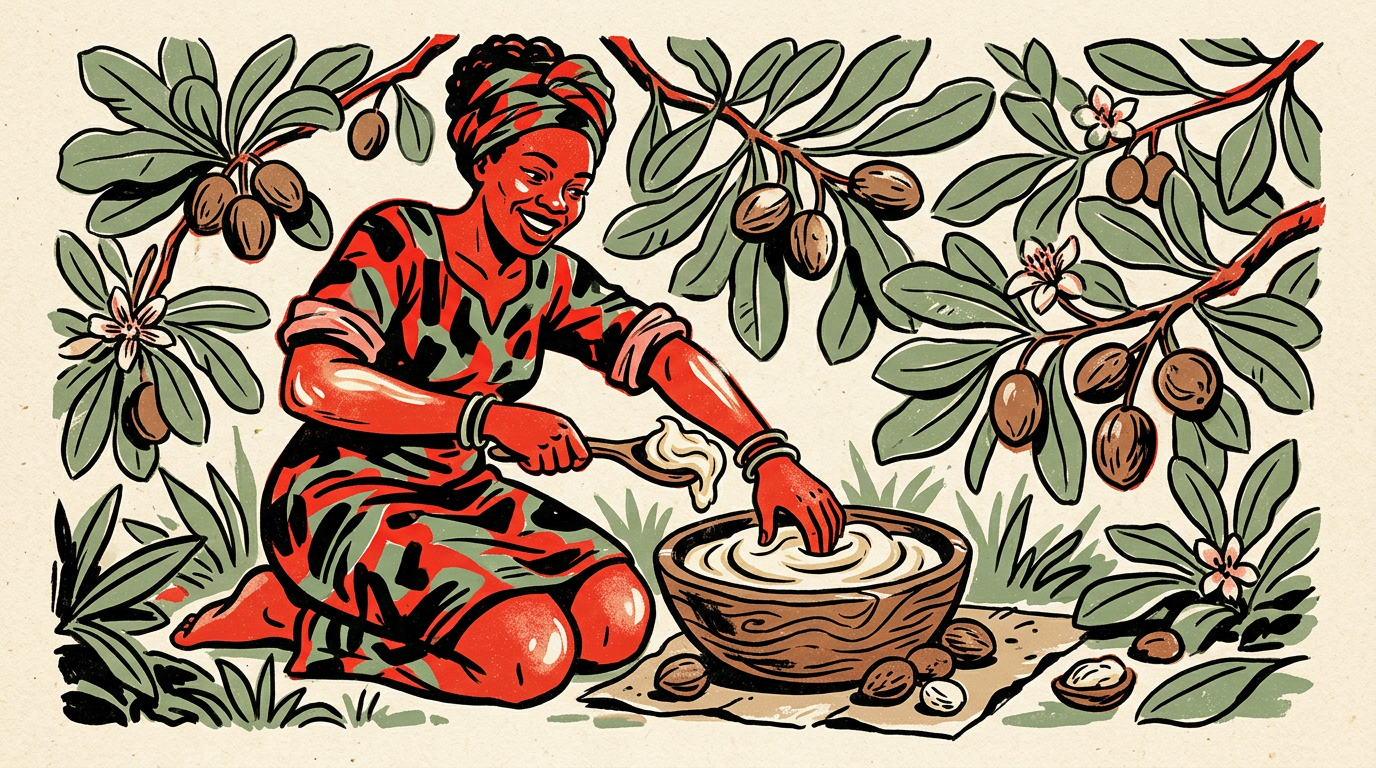
Many shea supply chains are tied to women’s cooperatives in West Africa and to cottage-scale production. Those social and economic factors influence the grade, consistency and price of the butter that reaches markets, but the clinical abstracts available here do not report on specific cooperative models or on comparative clinical performance of unrefined versus refined grades.13
Safety, tree-nut allergy and what to expect
The clinical abstracts in this set report good tolerability of shea-containing products in babies, children and adults, with low rates of irritation in the small trials and clinic studies cited. However, most safety data come from multicomponent products rather than isolated shea testing.4,5,8,9
Allergy concerns are pragmatic: some people with nut allergies worry about topical contact. None of the provided abstracts specifically evaluates systemic allergy risk or cross-reactivity to tree nuts after topical shea exposure, so the literature here does not establish safety for people with nut allergy. If there is a history of severe nut allergy, a clinician’s advice and targeted testing are reasonable precautions before widespread use.
Practical takeaway: for dry body skin, shea-containing lotions, butters and diaper-emollient systems perform like other occlusive emollients in small clinical studies and in practical use. The strongest evidence is that shea can be a useful component in multi-ingredient barrier creams and protective products, especially where petrolatum alternatives are desired and where shea is locally and affordably available.4,5,6
In the Botanical Index
Sources
- Vegetable Butters and Oils as Therapeutically and Cosmetically Active Ingredients for Dermal Use: A Review of Clinical Studies. — Poljšak N, Kočevar Glavač N. · Frontiers in pharmacology · 2022
- Novel phytoceramides containing fatty acids of diverse chain lengths are better than a single C18-ceramide N-stearoyl phytosphingosine to improve the physiological properties of human stratum corneum. — Oh MJ, Cho YH, Cha SY, Lee EO, Kim JW, Kim SK, Park CS. · Clinical, cosmetic and investigational dermatology · 2017
- Efficacy and safety of combination cream of stimu-tex AS™ (spent grain wax, Argania Spinosa Kernel oil, Butyrospermum Parkii (shea butter) extract), and saccharide isomerate after fractional CO2 laser procedure: split-face, double blinded, randomized controlled trial. — Sitohang IBS, Arimuko A, Norawati L, Maria R, Yulyana C, Nugraha RS, Amanda V, Indrafatina A, Amalia I. · Lasers in medical science · 2025
- Clinical Evaluation of a Diaper Containing a Shea Butter-Based Emollient and Impact on Diapered Skin Erythema. — O'Connor RJ, Visscher MO, Narendran V, Wang Y, Wiesemann F, Carr AN. · Pediatric dermatology · 2025
- Comparative trial of moisturizer containing spent grain wax, Butyrospermum parkii extract, Argania spinosa kernel oil vs. 1% hydrocortisone cream in the treatment of childhood atopic dermatitis. — Jirabundansuk P, Ophaswongse S, Udompataikul M. · Journal of the Medical Association of Thailand = Chotmaihet thangphaet · 2014
- Evidence-based treatment of atopic dermatitis with topical moisturizers. — Micali G, Paternò V, Cannarella R, Dinotta F, Lacarrubba F. · Giornale italiano di dermatologia e venereologia : organo ufficiale, Societa italiana di dermatologia e sifilografia · 2018
- The Role of Moisturizer Containing Anti-inflammatory on Skin Hydration in Mild-Moderate Atopic Dermatitis Patients. — Prakoeswa CRS, Damayanti, Anggraeni S, Umborowati MA, Sari M, Hendaria MP, Thahir TF. · Dermatology research and practice · 2024
- A pilot study investigating the efficacy of botanical anti-inflammatory agents in an OTC eczema therapy. — Draelos ZD. · Journal of cosmetic dermatology · 2016
- Patient acceptability, efficacy, and skin biophysiology of a cream and cleanser containing lipid complex with shea butter extract versus a ceramide product for eczema. — Hon KL, Tsang YC, Pong NH, Lee VW, Luk NM, Chow CM, Leung TF. · Hong Kong medical journal = Xianggang yi xue za zhi · 2015
- Clinical and confocal evaluation of avenanthramides-based daily cleansing and emollient cream in pediatric population affected by atopic dermatitis and xerosis. — Diluvio L, Dattola A, Cannizzaro MV, Franceschini C, Bianchi L. · Giornale italiano di dermatologia e venereologia : organo ufficiale, Societa italiana di dermatologia e sifilografia · 2019
- Moisturizing and antioxidant factors of skin barrier restoring cream with shea butter, silkflo and vitamin E in human keratinocyte cells. — Mohanan R, Jose SP, Sreevallabhan S, Jalam JK, Tilwani J, Jagmag T, Abhyankar M, George SM. · International journal of cosmetic science · 2025
- Effect of topically applied lipids on surfactant-irritated skin. — Lodén M, Andersson AC. · The British journal of dermatology · 1996
- Accessibility and affordability of emollients in the management of atopic dermatitis in Africa. — Otrofanowei E, Ahogo CK, Atadokpede F, Bahloul E, Cole-Adeife O, Dlova N, Doni SN, Faye O, Ibekwe PU, Kayitenkore K, Kebe M, Kombo Bayonne ES, Kouotou EA, Ly F, Mavura D, Nkosiyenzile C, Ouédraogo AN, Rakotonandrasana F, Fandresena S, Seudjip Nono LJ, Turki H, Ogu C, Rapelanoro Rabenja F. · The Journal of investigative dermatology · 2026
Discussion
0 commentsShare experiences, questions and sources. Be kind, and please don't give medical advice. Comments are checked before they appear, and anything that reads like a treatment claim goes to our editors first.
Join the conversation
A free reader account lets you comment and reply to other readers.
No comments yet. Start the discussion.