Origins · Rosehip
From Andean hedgerows to vanity shelves: a short history of rosehip
Rosehip has long served as food and a wartime vitamin source in Europe; modern cosmetic interest rests on laboratory, animal and a few human studies that show antioxidant, anti-inflammatory and wound‑healing potential, but most topical claims still rest on preclinical work.

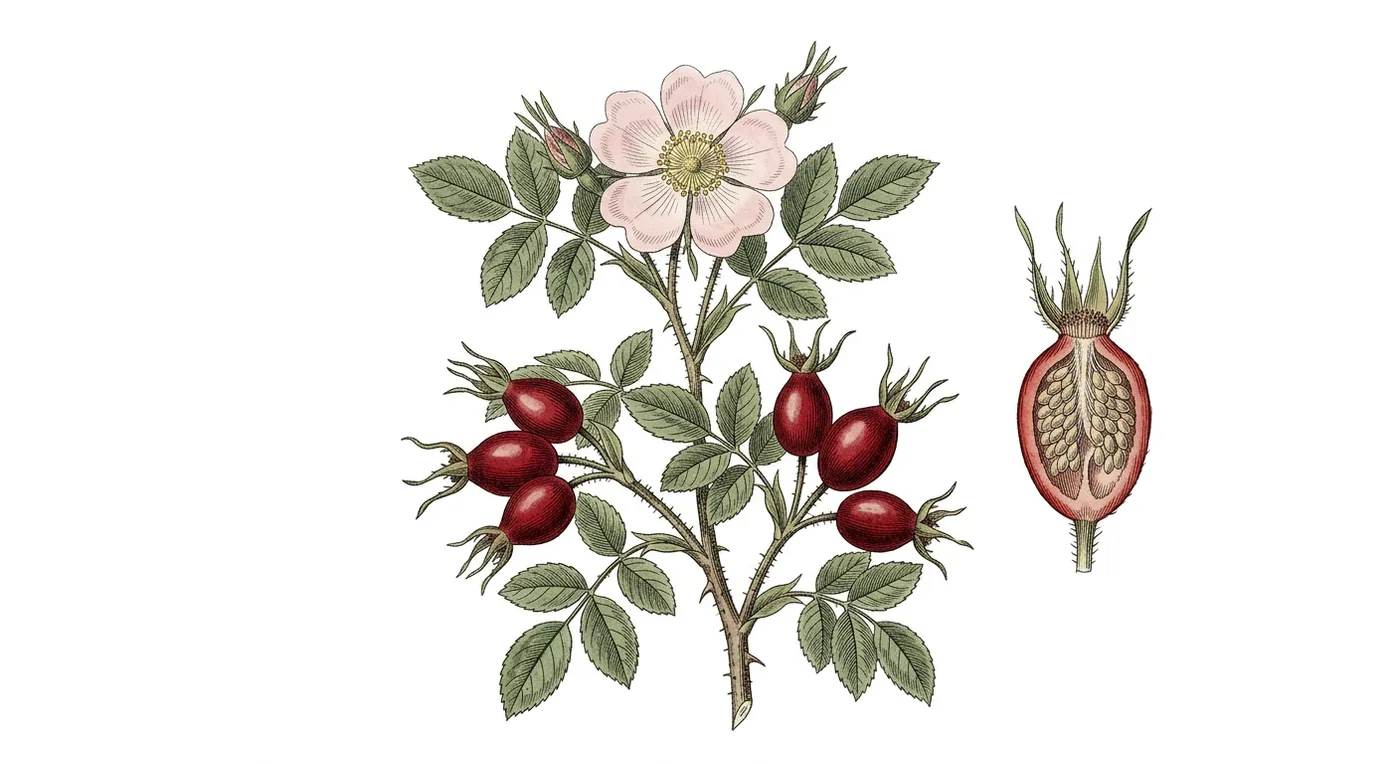
Rosehip — the fleshy fruit that follows a rose blossom — has a long domestic life in Europe as jam, syrup, tea and a source of vitamin C. Botanical and review work highlights a rich mix of vitamins, carotenoids, phenolics and oils that explain why it has been used both as food and folk medicine in many regions for decades and centuries.1,2,3,4,5
That popular, utilitarian history is the backdrop to a separate modern story: botanicals collected on hedgerows and roadsides later became raw materials for cosmetics. Wild rose hips were gathered for preserves and supplements long before the cosmetic industry distilled interest into seed oils, extracts and encapsulated formulations.
Science in the lab and clinic
A cluster of laboratory studies shows two consistent themes: rosehip fruits and seeds contain antioxidants and lipid profiles that are attractive for topical formulation, and delivery matters. Chemical and compositional analyses identify carotenoids, phenolic acids, tocopherols, vitamin C and unsaturated fatty acids in different Rosa species and ecotypes, and the levels vary by species and by drying or processing.3,4,5
rosehip fruits and seeds contain antioxidants and lipid profiles that are attractive for topical formulation
Work on formulation has focused on protecting those actives and helping them get through skin. Several in‑vitro studies encapsulated Rosa canina extracts in vesicles such as ethosomes or liposomes and reported strong antioxidant activity, good entrapment efficiencies, small particle sizes and acceptable fibroblast compatibility in cell assays; ethosomes in particular appeared promising as a carrier.6,7
In silico and early lab screens add suggested mechanisms: computer docking and target searches flag compounds from rosehip residues that could interact with enzymes linked to skin ageing, and short cytotoxicity tests have been used to gauge safety of seed extracts in cell lines.8
Animal studies offer preliminary evidence for healing and anti‑inflammatory effects. A topical rosehip oil emulsion increased fibroblast proliferation in cell tests and accelerated healing in a chemically induced oral ulcer model in rats, with reduced inflammatory cells and increased collagen deposition in the wound bed. In a separate mouse study, a topical rosehip extract cream reduced eczema‑like inflammation, skin thickness and dryness, producing effects described as comparable to a steroid control in that model.9,10
reduced inflammatory cells and increased collagen deposition in the wound bed
Human data are limited but not absent. One randomized, double‑blind controlled trial of an orally ingested, standardized rose hip powder reported improvements in crow’s‑feet wrinkles, skin moisture and elasticity over eight weeks compared with an active comparator. Safety assessments and toxicology reports also exist: an expert panel review concluded that a range of Rosa canina‑derived cosmetic ingredients are safe when formulated to be non‑irritating, and a 90‑day oral toxicology program on a standardized polyphenol extract found no genotoxicity and no observed adverse effect at the tested doses in rats.11,12,13
What the studies actually show for skin

Antioxidant and anti‑inflammatory activity are the best supported preclinical claims. Extracts and seed oil fractions show antioxidant effects in cell and chemical assays and reduced markers of inflammation or inflammatory appearance in animal models; these results support the idea that rosehip components can modulate oxidative stress and inflammation in controlled lab systems.6,7,8,9,10
Wound healing and barrier repair have been demonstrated in animals and in cell assays: experiments report increased fibroblast proliferation, more collagen in healing tissue, and thicker epithelium in treated wounds. That is encouraging, but animal mucosal or rodent skin models are not direct evidence for cosmetic effects on human facial skin.7,9
Claims around anti‑ageing and reductions in wrinkles rest on a mix of plausibility and limited human data. The single randomized trial in the literature tested an oral rose hip powder and reported measurable improvements in wrinkle parameters and skin mechanics over eight weeks; this speaks to possible systemic benefits of an oral product rather than topical oil in a jar.11
Topical evidence in humans is scarce. Most topical studies remain in vitro or in animals, or evaluate rosehip within a formulation or delivery system rather than as a neat oil, which makes it hard to assign benefit to a single constituent or to predict real‑world consumer outcomes.6,7,9,10,14
From fruit to oil: composition, quality and supply
Not all rosehips are the same. Species, growing region, harvest timing and post‑harvest processing change vitamin, phenolic and fatty‑acid profiles. Studies comparing fresh and dried fruits or different ecotypes document major variation in phenolics, carotenoids and fatty acids, which makes consistent raw material sourcing important for formulators.3,4,5
Valorization research also shows how much of the plant goes into non‑oil products: juice, powders and pomace can retain antioxidants and be processed into beverages or ingredients, offering economic pathways beyond seed oil. Analytical methods such as FT‑IR have been applied to authenticate and profile vegetable oils, including rosehip, as part of quality control.15,16
Harvesting is often done by small crews or community pickers in areas where wild roses grow, and many supply chains mix wild‑collected and cultivated sources. That social and ecological reality influences price, quality and traceability, but the specific labour arrangements vary by country and buyer and are not detailed in the laboratory literature.

Practical takeaways
Rosehip brings a mix of actives useful to skin science — vitamins, carotenoids, phenolics and unsaturated fatty acids — and formulation work has improved delivery, for example with ethosomes and liposomes. Those advances are rooted in in‑vitro and preclinical studies showing antioxidant, anti‑inflammatory and wound‑repair activity, and in at least one human oral study reporting skin improvements.6,7,8,9,10,11
Evidence for specific, repeatable topical benefits on human facial skin is still thin: most positive mechanistic and efficacy data come from cell assays and animal models, or from formulations that include rosehip alongside other actives. Safety reviews and toxicology work are reassuring when ingredients are used at customary cosmetic concentrations and are formulated to avoid irritation, but people with sensitive skin should be cautious.12,13,17
If skin concerns are medical — persistent inflammation, eczema, infection, or rapidly changing lesions — the appropriate step is a dermatologist. For cosmetic choices, awareness of raw‑material variability, delivery system and whether evidence comes from topical or oral studies will help separate marketing from what the science actually tested.
In the Botanical Index
Sources
- Recent advances and insights into the bioactive properties and applications of Rosa canina L. and its by-products. — Negrean OR, Farcas AC, Nemes SA, Cic DE, Socaci SA. · Heliyon · 2024
- Unveiling the mechanisms for the development of rosehip-based dermatological products: an updated review. — Oargă Porumb DP, Cornea-Cipcigan M, Cordea MI. · Frontiers in pharmacology · 2024
- Analysis of the GC-MS of volatile compounds and the phytochemical profile and antioxidant activities of some Bulgarian medicinal plants. — Mihaylova D, Vrancheva R, Desseva I, Ivanov I, Dincheva I, Popova M, Popova A. · Zeitschrift fur Naturforschung. C, Journal of biosciences · 2018
- Characterization of biochemical traits of dog rose (Rosa canina L.) ecotypes in the central part of Iran. — Javanmard M, Asadi-Gharneh HA, Nikneshan P. · Natural product research · 2018
- Phenolic, amino acids, and fatty acids profiles and the nutritional properties in the fresh and dried fruits of black rosehip (Rosa pimpinellifolia L.). — Pashaei M, Hassanpour H. · Scientific reports · 2024
- Design and Characterization of an Ethosomal Gel Encapsulating Rosehip Extract. — Sallustio V, Farruggia G, di Cagno MP, Tzanova MM, Marto J, Ribeiro H, Goncalves LM, Mandrone M, Chiocchio I, Cerchiara T, Abruzzo A, Bigucci F, Luppi B. · Gels (Basel, Switzerland) · 2023
- Extraction, Encapsulation into Lipid Vesicular Systems, and Biological Activity of Rosa canina L. Bioactive Compounds for Dermocosmetic Use. — Sallustio V, Chiocchio I, Mandrone M, Cirrincione M, Protti M, Farruggia G, Abruzzo A, Luppi B, Bigucci F, Mercolini L, Poli F, Cerchiara T. · Molecules (Basel, Switzerland) · 2022
- Mining bioactive components in agricultural crop and food production residue for sustainable solutions: In silico screening for skin anti-ageing properties. — Vidović S, Ilić M, Nakomčić J, Nastić N, Kvrgić J, Song X, Jakimov D, Galović AJ, Jovanović NL, Zloh M. · International journal of cosmetic science · 2025
- The Efficacy of Rosehip Oil Emulsion as a Pro-Healing Herbal Medicine for the Treatment of Induced Mucosal Ulcer (Cell Culture and Experimental Study). — Dewedar OAM, Habba DA, Zaki HA, Elamin EA, Ibrahim AA, Ahmed OE. · Oral health & preventive dentistry · 2025
- Investigating the effect of a herbal cream containing rose essence in an animal model of eczema. — Malayeri AR, Salimi A, Iraji F, Sabbagh S, Shakerian N, Khaledi M. · Avicenna journal of phytomedicine · 2025
- The effectiveness of a standardized rose hip powder, containing seeds and shells of Rosa canina, on cell longevity, skin wrinkles, moisture, and elasticity. — Phetcharat L, Wongsuphasawat K, Winther K. · Clinical interventions in aging · 2015
- Safety Assessment of Rosa canina-derived Ingredients as Used in Cosmetics. — Johnson W, Bergfeld WF, Belsito DV, Hill RA, Klaassen CD, Liebler DC, Marks JG, Shank RC, Slaga TJ, Snyder PW, Gill LJ, Heldreth B. · International journal of toxicology · 2022
- Evaluation of genotoxicity and subchronic toxicity of standardized rose hip extract. — Nagatomo A, Oguri M, Nishida N, Ogawa M, Ichikawa A, Tanaka-Azuma Y. · Human & experimental toxicology · 2018
- Synergism of plant extract and vegetable oils-based lipid nanocarriers: Emerging trends in development of advanced cosmetic prototype products. — Lacatusu I, Istrati D, Bordei N, Popescu M, Seciu AM, Panteli LM, Badea N. · Materials science & engineering. C, Materials for biological applications · 2020
- Valorization of Rosehip (Rosa canina L.) Pomace Using Unconventional Carbohydrate Carriers for Beverage Obtainment. — Michalska-Ciechanowska A, Brzezowska J, Nicolet N, Haładyn K, Brück WM, Hendrysiak A, Andlauer W. · Molecules (Basel, Switzerland) · 2025
- Statistical FT-IR Spectroscopy for the Characterization of 17 Vegetable Oils. — Kokalj Ladan M, Kočevar Glavač N. · Molecules (Basel, Switzerland) · 2022
- Anti-Inflammatory and Skin Barrier Repair Effects of Topical Application of Some Plant Oils. — Lin TK, Zhong L, Santiago JL. · International journal of molecular sciences · 2017
Discussion
0 commentsShare experiences, questions and sources. Be kind, and please don't give medical advice. Comments are checked before they appear, and anything that reads like a treatment claim goes to our editors first.
Join the conversation
A free reader account lets you comment and reply to other readers.
No comments yet. Start the discussion.