Botanical Index / everything about
Rosehip
Light seed oil with linoleic punch and folklore charm
Rosa canina
The short version
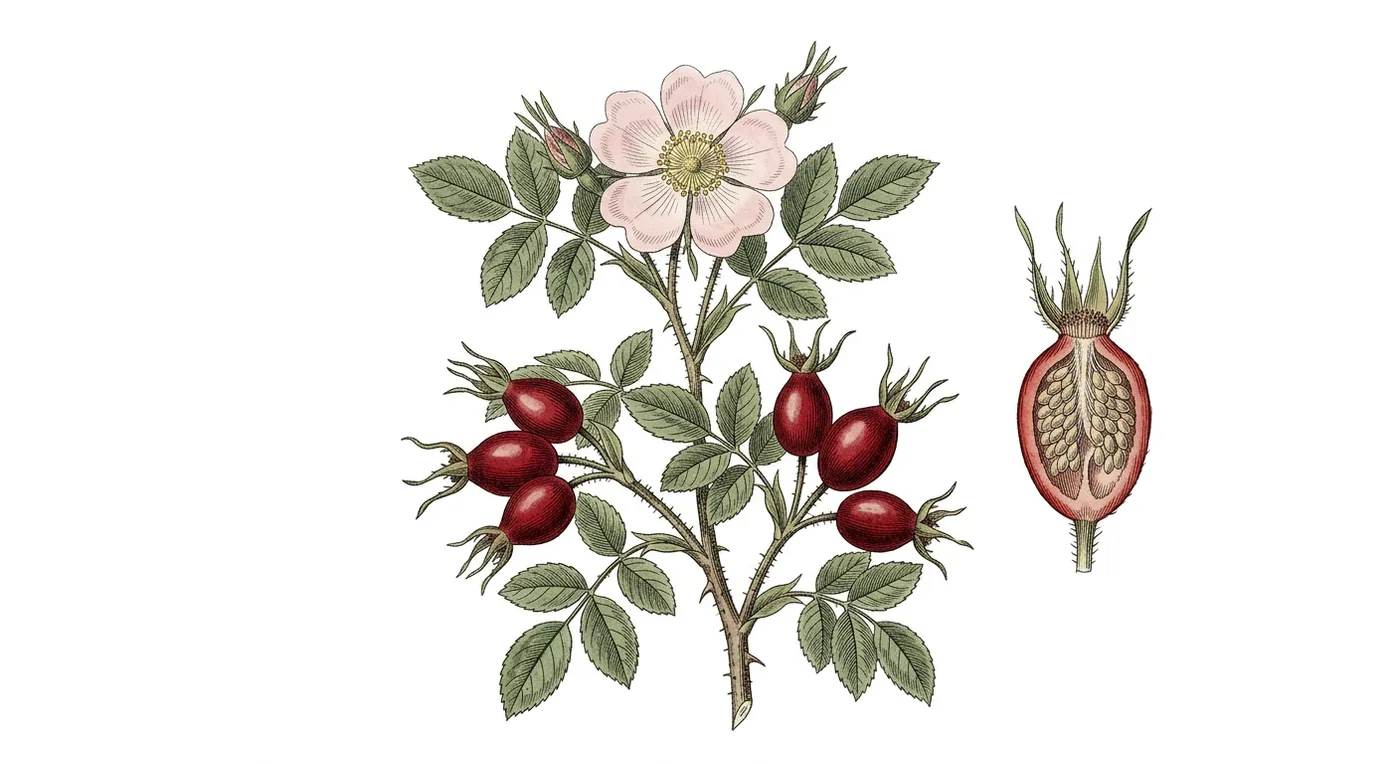
Rosehip is the bright fruit of wild roses; the cosmetic oil comes from its seeds. The seed oil feels light, sinks in quickly, and carries antioxidants and polyunsaturated fats that make skin feel softer and less tight.
- Family
- Rosaceae
- Part used
- Seed (cold-pressed oil)
- Comes from
- Europe, western Asia and north-west Africa; commercial oil also comes from Rosa rubiginosa grown in Chile
Good for?
Today it is used as a soft, fast-absorbing face and body oil to ease dryness and support the skin barrier. Lab and animal studies point to soothing and wound‑care potential, and a small human test suggests short‑term hydration gains. People also try it for scars, stretch marks and dark spots, but most human data use blends, not plain rosehip, so expectations should be modest. Early mouse work hints at hair‑growth support, but that remains preclinical.
Does it actually work?
Early days.
A few small studies on people. Interesting, not settled.
Evidence grade 3 out of 5.
“For topical skin benefits, the most direct human signal is a small experiment where rosehip oil increased short‑term hydration versus other oils.”
What the studies say
For topical skin benefits, the most direct human signal is a small experiment where rosehip oil increased short‑term hydration versus other oils. Animal and cell studies consistently show antioxidant, anti‑inflammatory and pro‑repair activity, and a mouse study found rosehip seed oil pushed follicles into a growth phase. A controlled pregnancy trial with a multi‑ingredient cream that included rosehip suggested fewer new stretch marks in a subgroup, but the blend prevents crediting rosehip alone. Several formulation papers pair rosehip with other actives or encapsulate extracts; useful for delivery science, but not proof of on‑skin outcomes. Robust, controlled trials of plain rosehip oil for specific skin concerns are still scarce.

What's inside
- Often the dominant fatty acid in seed oilLinoleic acid (ω‑6 PUFA)Linked to a lighter, fast‑absorbing feel; varies by species and processing.
- Commonly present in substantial amountsAlpha‑linolenic acid (ω‑3 PUFA)Contributes to a quick‑absorbing texture; more prone to oxidation.
- Moderate levelsOleic acid (ω‑9 MUFA)Balances texture and slip.
- Low to moderateTocopherols (vitamin E)Antioxidant components that help limit oxidation.
- Trace to low; gives a pale orange tintCarotenoids (e.g., beta‑carotene)Higher in unrefined oils; contributes color and antioxidant tone.
- Mainly in fruit/root extracts rather than refined seed oilPhenolic compounds (e.g., proanthocyanidins in extracts)Linked to antioxidant and enzyme‑modulating effects in vitro.
Read this first
Generally well tolerated as a cosmetic oil; patch test first if you’re sensitive. It’s rich in polyunsaturated fats, so it oxidizes faster than some oils—stale oil is more likely to irritate; store cool and use within its shelf life. Those with very reactive skin should introduce it slowly.
An expert panel review cited in the literature considers Rosa canina–derived cosmetic ingredients safe when formulated to be non‑irritating.
The stories
8 in the JournalLong Read · Rosehip
Rosehip oil for your face: what it can and can’t do
Rosehip oil has components that plausibly help dry, rough skin and may aid wound-related healing in lab and animal work; human evidence for scars, stretch marks and aging is limited and often comes from combinations or oral products rather than straight topical oil.
- Skin
Evidence Check · Rosehip
Rosehip oil for stretch marks: the trials, the blends and the caveats
A randomized, double-blind pregnancy trial found fewer new stretch marks in people who used a cream that included rosehip oil — but the product also contained several other actives, and the benefit was preventive rather than restorative.
- Body
Research Desk · Face oils
Face oils for oily skin: linoleic vs. oleic, ranked
The idea that 'linoleic oils are better for oily, acne-prone skin' rests largely on small lab studies and a few pilot clinical observations; the literature here is promising but mostly preclinical and frequently tests oils inside blends or nano‑formulations.
- Skin
Origins · Rosehip
From Andean hedgerows to vanity shelves: a short history of rosehip
Rosehip has long served as food and a wartime vitamin source in Europe; modern cosmetic interest rests on laboratory, animal and a few human studies that show antioxidant, anti-inflammatory and wound‑healing potential, but most topical claims still rest on preclinical work.
- Skin
Index Explainer · Face oils
How to use a face oil: before or after moisturizer, how many drops, when
A face oil is an occlusive finish: it doesn’t add water, it helps trap it. That makes it sensible as the last step on slightly damp skin. Lab work on rosehip and jojoba oils speaks to stability and safety; few studies test them alone as facial oils, so most practical rules come from how oils behave, not trials.
- Skin
Research Desk · Rosehip
Rosehip oil and dark spots: linoleic acid, vitamin A and pigmentation
Lab and animal work plus a few formulation studies point to plausible ways rosehip might influence pigmentation, but direct human evidence that rosehip oil by itself fades dark spots is very limited.
- Skin
Index Explainer · Rosehip
Cold-pressed vs. refined: how to tell good rosehip oil by color, smell and label
The pigments and fragile polyunsaturated fats that make rosehip oil amber, light and aromatic are easily lost in processing and storage. Lab studies of cold‑pressed rosehip oils show measurable carotenoids, tocopherols and volatile terpenes; a clear, scentless product often signals those components have been removed or reduced.
- Skin
Evidence Check · Rosehip
Will rosehip oil break you out? Comedogenicity, explained
Online 'comedogenic scores' are crude and dated; the best evidence on rosehip oil and breakouts comes from lab and animal studies, plus analyses of oil chemistry—not from controlled human trials of rosehip oil alone.
- Skin
Reviewed
Sources
- Polysaccharide Composites with Rosa canina for Sustained Anti-Inflammatory Skin Therapy. — Anghel N, Apostol I, Plaesu I, Mija A, Simionescu N, Coroaba A, Spiridon I. · Polymers · 2025
- Hair Growth-Promoting Effects of Rosehip (Rosa canina L.) Seed Oil in C57BL/6 Mice. — Truong VL, Jeong WS. · Preventive nutrition and food science · 2023
- Bioactive Compounds From Rosa canina L. Roots With Anti-Collagenase, Anti-Tyrosinase, and Antioxidant Activities: In Vitro and In Silico Approaches. — Subaş T, Özgen U, Kanbolat Ş, Badem M, Uzuner U, Özdemir G, Zeytineli Ş, Altunışık Ş, Cangul H, Eminağaoğlu Ö. · Chemistry & biodiversity · 2025
- Rosehip extract and wound healing: A review. — Belkhelladi M, Bougrine A. · Journal of cosmetic dermatology · 2024
- Investigating the effect of a herbal cream containing rose essence in an animal model of eczema. — Malayeri AR, Salimi A, Iraji F, Sabbagh S, Shakerian N, Khaledi M. · Avicenna journal of phytomedicine · 2025
- Polymeric Nanocapsules Containing Kojic Acid Dipalmitate and Rosehip Oil: Development and Evaluation of Preliminary Efficacy and Safety for Skin Whitening. — Capp Zilles J, Vallenot Lemos MA, Pedron Duarte L, Faccin Huth MP, Clemes Kulkamp Guerreiro I, C Carney B, Rigon Zimmer A, Vidor Contri R. · ACS omega · 2025
- Rosehip Extract-Loaded Liposomes for Potential Skin Application: Physicochemical Properties of Non- and UV-Irradiated Liposomes. — Jovanović AA, Balanč B, Volić M, Pećinar I, Živković J, Šavikin KP. · Plants (Basel, Switzerland) · 2023
- Design and Characterization of an Ethosomal Gel Encapsulating Rosehip Extract. — Sallustio V, Farruggia G, di Cagno MP, Tzanova MM, Marto J, Ribeiro H, Goncalves LM, Mandrone M, Chiocchio I, Cerchiara T, Abruzzo A, Bigucci F, Luppi B. · Gels (Basel, Switzerland) · 2023
- A systematic review on the Rosa canina effect and efficacy profiles. — Chrubasik C, Roufogalis BD, Müller-Ladner U, Chrubasik S. · Phytotherapy research : PTR · 2008
- Use of a specific anti-stretch mark cream for preventing or reducing the severity of striae gravidarum. Randomized, double-blind, controlled trial. — García Hernández JÁ, Madera González D, Padilla Castillo M, Figueras Falcón T. · International journal of cosmetic science · 2013
- The effectiveness of a standardized rose hip powder, containing seeds and shells of Rosa canina, on cell longevity, skin wrinkles, moisture, and elasticity. — Phetcharat L, Wongsuphasawat K, Winther K. · Clinical interventions in aging · 2015
- Optimisation of ultrasound-assisted extraction of rosehip (Rosa canina L.) with response surface methodology. — Ilbay Z, Sahin S, Kırbaşlar Sİ. · Journal of the science of food and agriculture · 2013
- Unveiling the mechanisms for the development of rosehip-based dermatological products: an updated review. — Oargă Porumb DP, Cornea-Cipcigan M, Cordea MI. · Frontiers in pharmacology · 2024
- In Vitro and In Vivo Characteristics of Olive Oil as Excipient for Topical Administration. — Rodríguez-Torrado M, Kara A, Torrado S, Romero A, Juberías A, Torrado JJ, Serrano DR. · Pharmaceutics · 2022
- The Efficacy of Rosehip Oil Emulsion as a Pro-Healing Herbal Medicine for the Treatment of Induced Mucosal Ulcer (Cell Culture and Experimental Study). — Dewedar OAM, Habba DA, Zaki HA, Elamin EA, Ibrahim AA, Ahmed OE. · Oral health & preventive dentistry · 2025
- Anti-Inflammatory and Skin Barrier Repair Effects of Topical Application of Some Plant Oils. — Lin TK, Zhong L, Santiago JL. · International journal of molecular sciences · 2017