Index Explainer · Rosehip
Cold-pressed vs. refined: how to tell good rosehip oil by color, smell and label
The pigments and fragile polyunsaturated fats that make rosehip oil amber, light and aromatic are easily lost in processing and storage. Lab studies of cold‑pressed rosehip oils show measurable carotenoids, tocopherols and volatile terpenes; a clear, scentless product often signals those components have been removed or reduced.
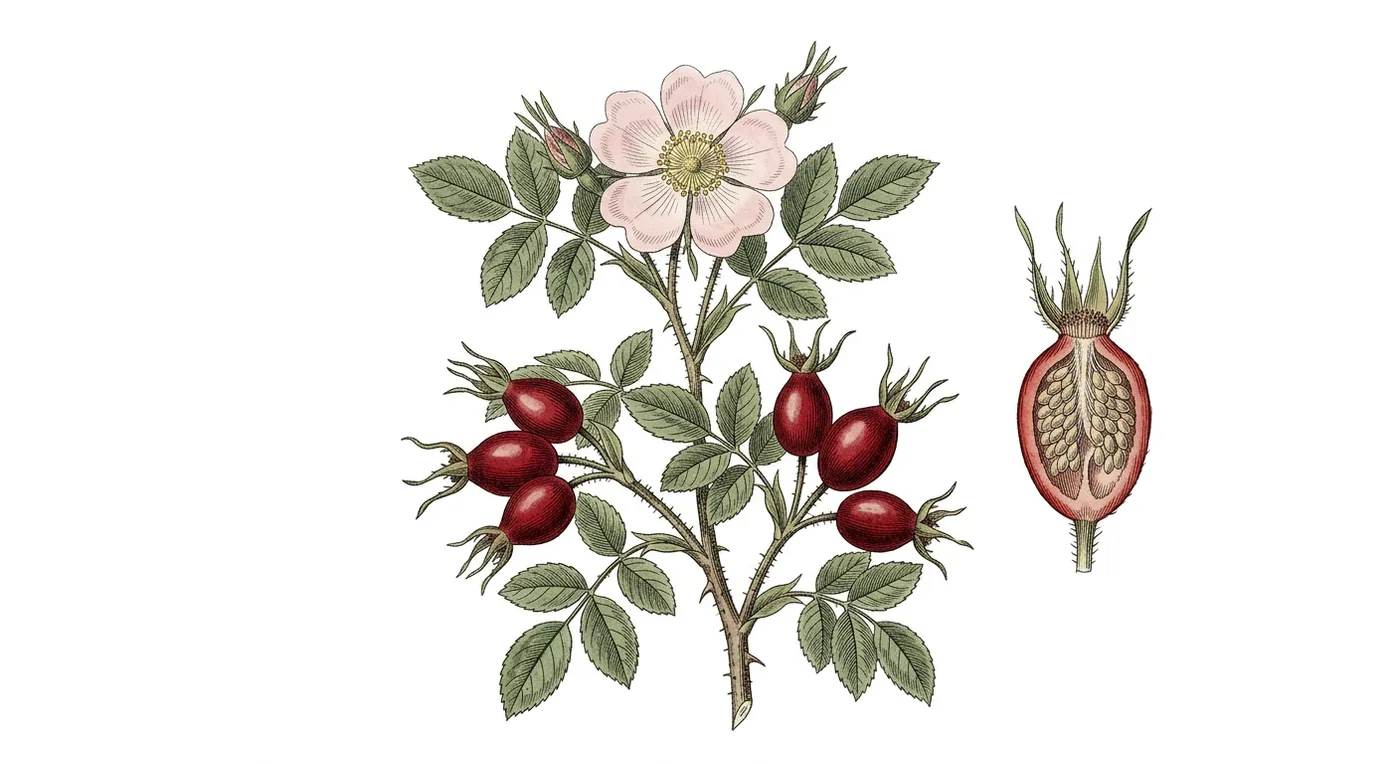
Rosehip seed oil on a shelf can range from deep amber to almost colorless and from faintly floral to neutral. Analytical work on cold‑pressed rosehip oils finds carotenoids, tocopherols and other lipophilic antioxidants alongside a characteristic volatile profile dominated by terpenes; these constituents give the oil its color, aroma and much of its chemical vulnerability in storage and formulation. Laboratory characterizations and reviews of Rosa canina list the pigments and fat profile as key markers of cold‑pressed seed oil quality.1,2,3,4
That chemical picture matters for skin use. The long‑chain polyunsaturated fatty acids and lipophilic antioxidants that make rosehip seed oil light and biologically active are fragile: heat, oxygen and light drive oxidation and pigment loss. Multiple studies of cold‑pressed seed oils identify tocopherols, phenolic compounds and carotenoids as contributors to antioxidant capacity and to measured oxidative stability, which in turn influences shelf life and sensory traits.2,3,5,6
tocopherols, phenolic compounds and carotenoids as contributors to antioxidant capacity

Processing: cold‑pressed and refined, and what they keep
Cold‑pressing (low‑temperature mechanical extraction) of rosehip seeds preserves the oil’s native profile: analyses of commercially available cold‑pressed rosehip oils report measurable carotenoid and tocopherol content and a fatty acid mix high in unsaturated fats. Those same analytical studies use chromatography and spectrophotometry to quantify pigments and volatile compounds that give the oil its amber color and aroma.1,2,4
The literature characterizes cold‑pressed rosehip oil as a source of polyunsaturated fatty acids and lipophilic antioxidants; reviews of Rosa canina note these constituents as the reason the seed oil is used in nutrition and cosmetics. Because those pigments and antioxidants are lipophilic, they show up in the oil’s color and in assays of radical‑scavenging capacity conducted on oil fractions.1,3,6
Refining processes—which the reviewed literature contrasts with cold‑pressed virgin oils—tend to reduce or remove lipophilic pigments, volatiles and some antioxidants. The analytical markers that distinguish authentic cold‑pressed oils from processed ones include color metrics, tocopherol and carotenoid levels and the volatile profile; rapid spectrophotometric and chromatographic methods have been proposed to discriminate botanical origin and processing state by these measures.1,2,4
Color and smell as quick quality checks
Color correlates with pigment content in rosehip seed oil. In laboratory analyses, higher carotenoid readings match richer amber hues; researchers have used spectrophotometric color data to distinguish botanical species and to flag oils with authentic cold‑pressed profiles. Practically, a warm amber tone is consistent with detectable carotenoids in cold‑pressed samples.1,2,4
Aromatic compounds in cold‑pressed rosehip oil are detectable by chromatographic profiling and are often terpene‑rich; those volatiles account for the earthy or slightly floral notes people describe. When the volatile fraction is low or absent, the oil will be bland or nearly scentless in lab and sensory work. That pattern is why a neutral, clear oil is often a reasonable signal that the pigments and volatiles have been reduced—though analytical confirmation would be needed to know exactly what was removed.1,4
When the volatile fraction is low or absent, the oil will be bland or nearly scentless in lab and sensory work.
Color and smell are immediate cues, but they are imperfect. Lab studies emphasize that antioxidant content and oxidative stability are quantitative traits best measured by peroxide and p‑anisidine values or by chromatographic assays of tocopherols and phenolics, not by smell alone.2,6
Reading the label: species, INCI and blends

Scientific and regulatory names are the clearest signals on an INCI list. The peer‑reviewed literature on Rosa canina is the primary source base for cosmetic and nutritional work on ‘rosehip’; many analytical data sets and reviews use Rosa canina as the reference species. If the INCI lists Rosa canina (or the Latin binomial used locally), the raw material aligns with the identity used in the cited chemical literature.3,4
Labels that say simply ‘rosehip oil’ without a botanical name, or that indicate ‘blend’ or list multiple oils, provide less assurance about what you’re getting. Research that uses rosehip seed oil in composite formulations—for example in active packaging or biocomposites—illustrates how small proportions of a specialty oil may be incorporated into blends for antioxidant or antimicrobial purposes; such studies do not tell you the percent of rosehip oil in a commercial blend, only that blending is common in product development.7,8
A listed harvest or production date and an expiration or best‑by date are useful because the stability literature shows that antioxidant levels and peroxide values change during storage. Neither a botanical name nor a date guarantees quality on its own, but both are evidence of traceable sourcing and attention to shelf life.2,5,6

Storage, shelf life and signs of oxidation
Analytical work on cold‑pressed oils shows that oxidative stability depends on the balance of unsaturated fatty acids and available antioxidants such as tocopherols, phytosterols and phenolics. Studies of cold‑pressed seed oils—including rosehip—identify tocopherols and other lipophilic antioxidants as major determinants of antiradical capacity and of the rate at which peroxide values rise during storage.2,5,6
Laboratory assays track oxidation with peroxide and p‑anisidine values and with differential scanning calorimetry; those methods register the same processes that, in practical terms, produce off‑smells and loss of pigment and functional compounds. Research emphasizes that low ratios of protective antioxidants to highly unsaturated fatty acids correlate with faster oxidation, so an oil with high α‑linolenic or linoleic content needs proportionally stronger antioxidant protection to remain stable.2,5,6
Because pigments and volatiles are light‑ and oxygen‑sensitive, the analytical literature and product‑development studies commonly use dark containers and antioxidant‑friendly formulations; they also test storage at different temperatures to model shelf life. These data underpin the practical recommendation to prefer oils that carry a production date, are sold in opaque or dark glass, and are stored away from heat and sunlight.2,5,7
A short, evidence‑based checklist for buying and storing
Prefer ‘cold‑pressed’ or ‘virgin’ seed oil with a botanical name (Rosa canina appears most often in the chemical literature). Analytical studies of cold‑pressed rosehip oils show the pigment and antioxidant profile that people expect from an unrefined seed oil.1,2,3
Amber color and a faint, terpene‑rich aroma are consistent with measurable carotenoids and volatiles in lab analyses; a completely clear, scentless oil often indicates those compounds have been reduced or removed during processing.1,2,4
Look for a production or bottling date and for storage in dark glass or opaque packaging. Cold‑pressed oil composition studies and stability work document pigment and antioxidant loss over time and under light exposure, so packaging and dates matter for how much of the original profile remains.2,5,6
If you need the oil for a specific skin concern, remember that the peer‑reviewed literature on rosehip often reports compositional and antioxidant data rather than clinical outcomes, and the papers here are laboratory analyses and reviews rather than controlled skin trials. For medical advice about skin conditions, consult a dermatologist.2,3,6
In the Botanical Index
Sources
- Determination of main lipids and volatile compounds in unconventional cold-pressed seed oils through chromatographic techniques. — Rigano F, Vento F, Cafarella C, Trovato E, Trozzi A, Dugo P, Mondello L. · Journal of food science · 2025
- Characteristics of rose hip (Rosa canina L.) cold-pressed oil and its oxidative stability studied by the differential scanning calorimetry method. — Grajzer M, Prescha A, Korzonek K, Wojakowska A, Wojakowska A, Dziadas M, Kulma A, Grajeta H. · Food chemistry · 2015
- Recent advances and insights into the bioactive properties and applications of Rosa canina L. and its by-products. — Negrean OR, Farcas AC, Nemes SA, Cic DE, Socaci SA. · Heliyon · 2024
- Potentialities of Rapid Analytical Strategies for the Identification of the Botanical Species of Several "Specialty" or "Gourmet" Oils. — Turrini F, Zunin P, Boggia R. · Foods (Basel, Switzerland) · 2021
- Characteristics and Antioxidant Potential of Cold-Pressed Oils-Possible Strategies to Improve Oil Stability. — Grajzer M, Szmalcel K, Kuźmiński Ł, Witkowski M, Kulma A, Prescha A. · Foods (Basel, Switzerland) · 2020
- The Antioxidant Activity and Oxidative Stability of Cold-Pressed Oils. — Prescha A, Grajzer M, Dedyk M, Grajeta H. · Journal of the American Oil Chemists' Society · 2014
- Active Cellulose-Based Food Packaging and Its Use on Foodstuff. — Irimia A, Grigoraș VC, Popescu CM. · Polymers · 2024
- PLA-Based Materials Containing Bio-Plasticizers and Chitosan Modified with Rosehip Seed Oil for Ecological Packaging. — Darie-Niță RN, Râpă M, Sivertsvik M, Rosnes JT, Popa EE, Dumitriu RP, Marincaș O, Matei E, Predescu C, Vasile C. · Polymers · 2021
Discussion
0 commentsShare experiences, questions and sources. Be kind, and please don't give medical advice. Comments are checked before they appear, and anything that reads like a treatment claim goes to our editors first.
Join the conversation
A free reader account lets you comment and reply to other readers.
No comments yet. Start the discussion.