Myth Busting · Rosehip
Rosehip, retinol and the “natural retinol” myth
Many product pages call rosehip oil “nature’s retinol.” The papers supplied here show rosehip as a source of carotenoids, vitamin C, tocopherols and PUFAs and include small in‑vitro and animal studies of wound healing, hair growth and antioxidant activity. They do not, in themselves, establish that rosehip contains meaningful retinoic acid or that it reproduces the clinical effects of pharmaceutical retinoids.

The short version: the studies you supplied show what rosehip oils and fruits contain and what small lab and animal experiments have found, but they do not demonstrate that rosehip oil is a botanical source of retinoic acid or that it reproduces prescription retinoid outcomes.1,2,3
That gap matters because carotenoids, vitamins and fatty acids — the compounds repeatedly reported in composition studies and reviews of Rosa species — are biologically different from retinoids. The composition work and reviews in this set emphasize carotenoids, tocopherols, vitamin C and polyunsaturated fatty acids as rosehip’s major bioactives rather than retinoic acid or retinol itself.1,2,3,4,5
they do not demonstrate that rosehip oil is a botanical source of retinoic acid

What’s actually in rosehip oil, according to these papers
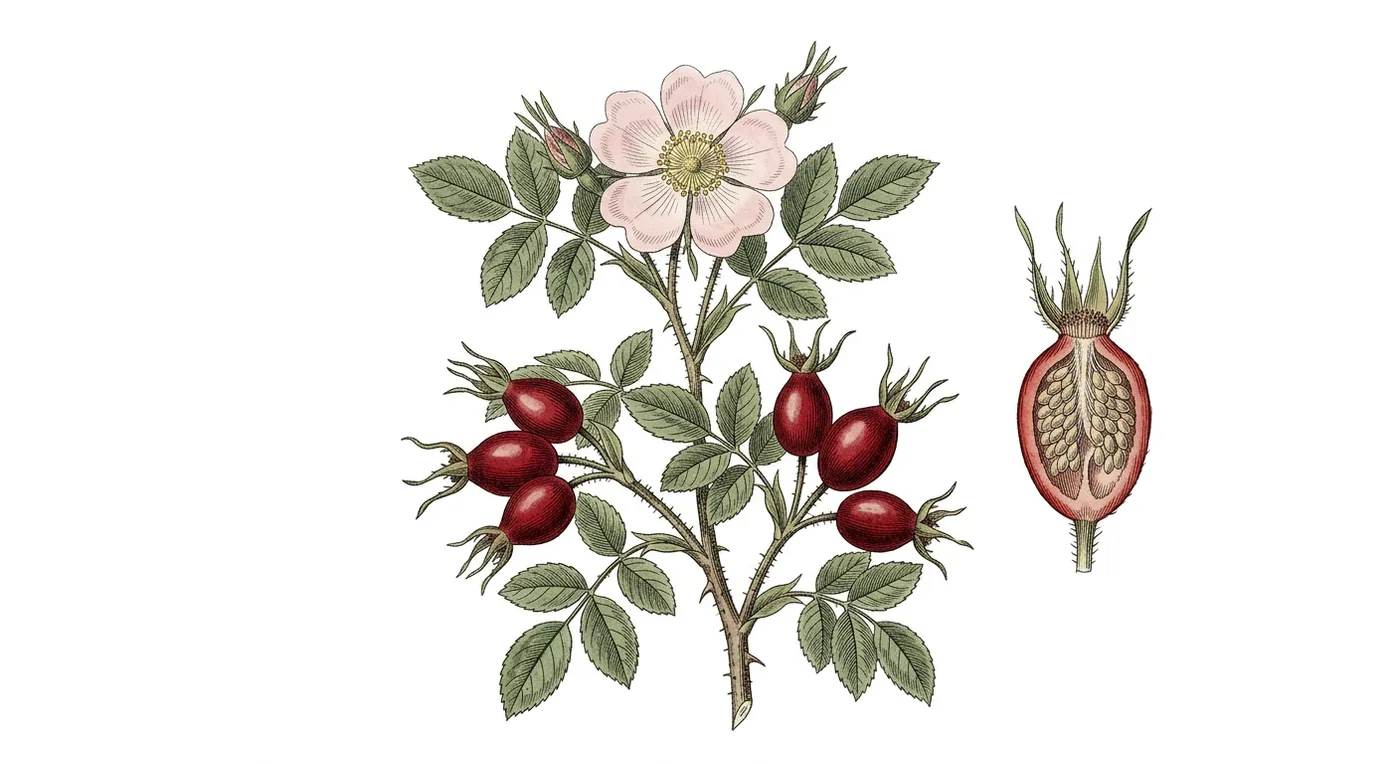
Chemical analyses of commercially available rosehip oils and of wild and cultivated rosehip fruits in these abstracts report high proportions of polyunsaturated fatty acids (notably linoleic and α‑linolenic acids), carotenoids, tocopherols and substantial vitamin C in the fruit—components consistent across multiple geographic samples and genotypes.1,4,5,6
Analytical studies also measured antioxidant capacity and oxidation kinetics: rosehip oil shows measurable antioxidant content but — under accelerated thermal testing — lower oxidative stability compared with some other oils, a behaviour that aligns with its relatively high PUFA content.1,7
Multiple reviews synthesize these findings and highlight rosehip’s phenolic compounds, carotenoids and vitamins as the likely mediators of its antioxidant and anti‑inflammatory signals, while noting that research remains fragmented and clinical validation is limited.2,3,8
Why that is not the same as a retinoid
The abstracts here do not report the presence of retinol or trans‑retinoic acid in rosehip oil; instead they characterise carotenoids, vitamin C, tocopherols and PUFAs as the dominant constituents. Those are different chemical classes from retinoids and have different pharmacology.1,2,3,4
Because the supplied papers focus on composition, formulation and small experimental models, there is no direct evidence among them that rosehip delivers the epidermal remodelling and well‑documented clinical effects associated with topical retinoid therapy; the reviews explicitly flag limited clinical validation of many rosehip applications.2,3
What rosehip actually does in the lab and in animals
Topical and oral rosehip preparations show modest preclinical signals: rosehip seed oil improved wound closure and markers of epithelial regeneration in fibroblast cultures and in a rat excisional‑wound model, with increased VEGF and TGF‑β expression reported in the animal experiments.9
A rosehip oil emulsion stimulated human gingival fibroblast proliferation in cell assays and accelerated healing of chemically induced oral ulcers in rats, with reduced inflammatory cells and greater collagen deposition at early time points.10
In hair‑regrowth work, topical rosehip seed oil applied to dorsal skin of telogenic mice accelerated the telogen→anagen transition, increasing follicle density, bulb size and skin thickness and upregulating several hair‑growth–associated genes in that animal model.11
Separate formulation and in‑vitro studies pair rosehip oil with other actives (for example in nanocapsules or nanoemulsions) and report antioxidant activity, tyrosinase inhibition or permeation of co‑formulated actives into the epidermis, but these are formulation‑level findings rather than proof that rosehip alone produces a given clinical outcome.12,13
Put bluntly: the experimental signal in the supplied data is real but limited — mostly cell and animal work and in‑vitro formulation testing rather than randomized human trials showing retinoid‑level skin changes.2,3,9,10,11,12,13
mostly cell and animal work and in‑vitro formulation testing

Rosehip and retinoids together: what the literature here shows
Several formulation studies in this set intentionally combine rosehip oil with retinoid or retinoid‑like actives. A nanoemulsion study described a product containing black seed oil, rosehip oil and retinol with in‑vitro antimicrobial and anti‑inflammatory activity and good cell viability in culture, and it reported better performance than a comparative gel in their experimental assays.14
Work on kojic‑dipalmitate nanocapsules and nanoemulsions that include rosehip oil reports enhanced antioxidant and depigmenting activity in vitro and adequate epidermal delivery of the co‑actives, suggesting rosehip’s antioxidant or regenerative components can be useful formulation partners.12,13
Those papers show formulation‑level synergy or stabilizing effects, but they do not prove that adding rosehip to a topical retinoid will reliably prevent retinoid‑associated dryness or irritation in patients; clinical trials specifically testing that question are not present in this set.2,12,13,14
Practical takeaways
If you want the specific, well‑documented outcomes associated with pharmaceutical retinoids, the studies supplied here do not establish rosehip oil as a replacement. The composition papers and reviews show carotenoids, vitamin C, tocopherols and PUFAs as rosehip’s main bioactives, and the experimental literature is primarily cell and animal work rather than human topical trials that reproduce retinoid endpoints.1,2,3,4,5,6,9,10,11
That said, rosehip oil is a bona fide botanical with antioxidant and pro‑healing signals in preclinical studies and it is used in formulations to support antioxidant activity, skin regeneration and co‑delivery of other actives; formulation studies combining rosehip with retinoids or depigmenting agents show promising in‑vitro results but stop short of clinical confirmation.9,10,11,12,13,14
If dryness or irritation from a retinoid is your concern, the published formulation work suggests formulation strategies exist to combine antioxidant and skin‑supporting oils with retinoids, but clinicians and patients should rely on controlled clinical evidence for tolerability strategies. For medical skin concerns, consult a dermatologist.2,12,13,14
In the Botanical Index
Sources
- Characterization of Bulgarian Rosehip Oil by GC-MS, UV-VIS Spectroscopy, Colorimetry, FTIR Spectroscopy, and 3D Excitation-Emission Fluorescence Spectra. — Nikolova K, Eftimov T, Panova N, Vladev V, Fouzar S, Nikolov K. · Molecules (Basel, Switzerland) · 2025
- Recent advances and insights into the bioactive properties and applications of Rosa canina L. and its by-products. — Negrean OR, Farcas AC, Nemes SA, Cic DE, Socaci SA. · Heliyon · 2024
- Rosehip (Rosa spp.) as a Source of Bioactive Compounds for Functional Foods and Therapeutic Applications. — Mao Q, Zhou M, Lei L, Zhang Y, Chen H, Zhu B, Luo L, Yu C. · Journal of agricultural and food chemistry · 2026
- Phytochemical Composition, Elemental Profiles, Antioxidant Activity, and Xenobiotic Relevance of Rosehip and Sea Buckthorn Fruits from Armenia. — Sahakyan L, Tsaturyan A, Minasyan E, Hayrapetyan L, Chakhoyan A, Mirzoyan V, Zakaryan N, Palumbo R, Vicidomini C, Roviello GN, Saghyan A. · Journal of xenobiotics · 2026
- Pomological and Biochemical Properties of Rosehip (Rosa canina L.) Genotypes. — Ertugrul E, Aglar E, Ozturk B, Tekin O, Alan D, Ates U. · Food science & nutrition · 2026
- Longitudinal metabolomic profiling of rosehips from six wild Rosa species grown under common-garden conditions: ripening dynamics, taste-associated metabolites, and antioxidant profile. — Chiocchio I, Trincia S, Smeriglio A, Trombetta D, Najlaoui A, Tarozzi C, Poli F, Mandrone M. · Food chemistry · 2026
- Oxidative Stability and Kinetics of Oxidation of Rosehip, Sunflower, Olive and Jojoba Oils. — Fagoaga C, Moreno A, Fernández-Julián N, Castellano G. · Antioxidants (Basel, Switzerland) · 2026
- New horizon of rosehip seed oil: Extraction, characterization for its potential applications as a functional ingredient. — Saini A, Kaur R, Kumar S, Saini RK, Kashyap B, Kumar V. · Food chemistry · 2024
- Phytotherapeutic evaluation of rosehip seed and olive oils on wound healing: evidence from L929 cell culture and in vivo VEGF/TGF-β analysis. — Aydin Acar C, Kiyak FG, Pehlivanoglu S, Yesilot S, Ozmen O. · 3 Biotech · 2025
- The Efficacy of Rosehip Oil Emulsion as a Pro-Healing Herbal Medicine for the Treatment of Induced Mucosal Ulcer (Cell Culture and Experimental Study). — Dewedar OAM, Habba DA, Zaki HA, Elamin EA, Ibrahim AA, Ahmed OE. · Oral health & preventive dentistry · 2025
- Hair Growth-Promoting Effects of Rosehip (Rosa canina L.) Seed Oil in C57BL/6 Mice. — Truong VL, Jeong WS. · Preventive nutrition and food science · 2023
- Polymeric Nanocapsules Containing Kojic Acid Dipalmitate and Rosehip Oil: Development and Evaluation of Preliminary Efficacy and Safety for Skin Whitening. — Capp Zilles J, Vallenot Lemos MA, Pedron Duarte L, Faccin Huth MP, Clemes Kulkamp Guerreiro I, C Carney B, Rigon Zimmer A, Vidor Contri R. · ACS omega · 2025
- Nanoemulsion Containing Kojic Dipalmitate and Rosehip Oil: A Promising Formulation to Treat Melasma. — Zilles JC, Duarte LP, Ruaro TC, Zimmer AR, Kulkamp-Guerreiro IC, Contri RV. · Pharmaceutics · 2023
- Evaluation of a Retinol Nanoemulsion Gel Enriched with Black Seed and Rosehip Oils for Acne Management. — Reddy A, Ravichandran A, Magham SV. · Drug research · 2025
Discussion
0 commentsShare experiences, questions and sources. Be kind, and please don't give medical advice. Comments are checked before they appear, and anything that reads like a treatment claim goes to our editors first.
Join the conversation
A free reader account lets you comment and reply to other readers.
No comments yet. Start the discussion.