Research Desk · Rosehip
Rosehip oil and dark spots: linoleic acid, vitamin A and pigmentation
Lab and animal work plus a few formulation studies point to plausible ways rosehip might influence pigmentation, but direct human evidence that rosehip oil by itself fades dark spots is very limited.

Claims that rosehip oil lightens dark spots rest on two kinds of material: compositional and mechanistic papers that show the oil contains carotenoids, vitamins and polyunsaturated fatty acids, and a small body of lab and animal research that tests rosehip extracts or formulas for effects on melanin or tyrosinase. That mix creates plausible hypotheses, but it stops short of solid clinical proof that rosehip oil alone meaningfully reduces hyperpigmentation.1,2,3,4
Put bluntly: there are a few clear lab and animal signals, several formulation studies that pair rosehip with known depigmenting actives, and a number of analytical or review articles describing compounds in rosehip that could, in principle, alter pigment biology. There are no controlled human trials in these papers showing that rosehip oil by itself lightens established dark spots.1,2,3,4,5,6,7
There are no controlled human trials in these papers showing that rosehip oil by itself lightens established dark spots.
Because the literature here mixes seed oil, whole-fruit extracts and multi-ingredient formulations, it is important to separate what is known about composition from what has been tested for pigment outcomes. The rest of this piece follows that distinction.

What’s in rosehip and why any of it might matter
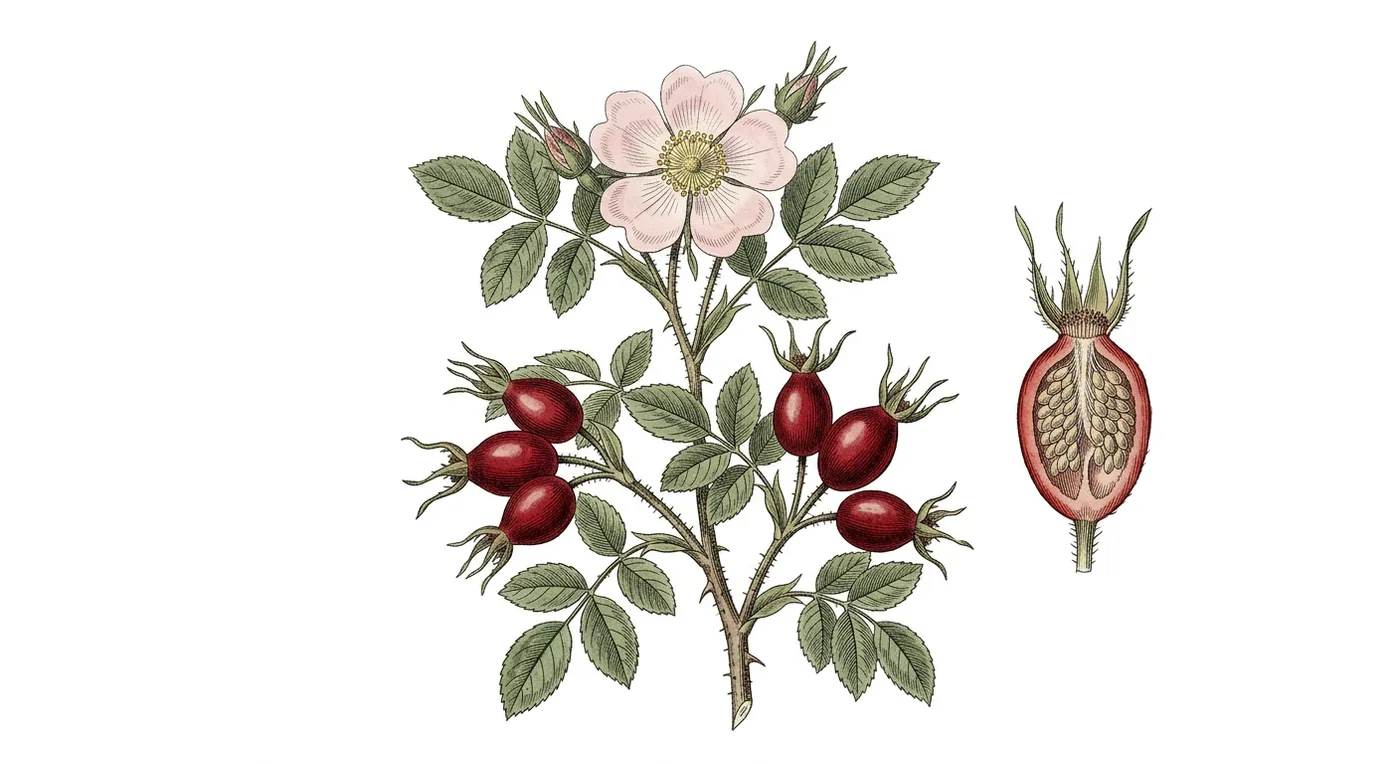
Rosehip fruits and their seed oils contain a mix of vitamins, carotenoids and polyunsaturated fatty acids. Reviews and compositional studies repeatedly list vitamin C and carotenoids among the prominent constituents, and analytical work on commercial oils documents high proportions of linoleic acid (an ω‑6 polyunsaturated fatty acid) in seed oil samples. That biochemical profile is the source of most mechanistic interest for pigmentation.1,2,3,4,8
Antioxidant and enzyme‑modulating chemistry is the usual mechanistic route proposed. Reviews of rosehip phytochemistry highlight antioxidants and phenolic compounds that could plausibly affect pathways relevant to pigmentation, and one cell study fractionated aqueous rosehip extract to identify proanthocyanidins as an inhibitor of tyrosinase activity in melanoma cell lysates. Those findings establish biological plausibility but do not themselves demonstrate clinical benefit on human hyperpigmentation.1,2,7
Separately, seed oil fatty‑acid profiles vary by sample and species. GC‑MS studies report different ω‑3/ω‑6 balances across commercial oils and show linoleic acid often present in substantial percentages. That variability matters because different preparations (whole fruit vs. seed oil) will deliver different mixes of carotenoids, vitamins and fatty acids to the skin or systemic circulation.3,8,9,10
Note on terminology: several papers study whole‑fruit extracts or seed oil, and some study rosehip as an ingredient within a multi‑component delivery system. Results from those different preparations are not interchangeable.3,4,6
Lab and animal evidence

The most direct experimental evidence that rosehip material can alter melanogenesis comes from an older study that used an aqueous extract fraction. That work showed the 50% ethanol eluate of a rosehip aqueous extract reduced melanin production in B16 mouse melanoma cells, inhibited intracellular tyrosinase activity and produced less pigmentation when administered orally to brown guinea pigs, along with lower tyrosinase activity in skin samples. Those are cell and animal findings, not human clinical outcomes.7
Nanocarrier and nanoemulsion studies have tested formulations that combine rosehip oil with an established depigmenting ester of kojic acid (kojic dipalmitate). Two recent formulation papers report stable nanoparticulate systems in which the combination showed antioxidant capacity, skin permeation of the depigmenting ester, and in‑vitro tyrosinase inhibition. Because kojic dipalmitate is a known depigmenting agent and was the active component in those tests, the data do not isolate any specific contribution from rosehip oil to pigment reduction.5,6
Other preclinical work with rosehip seed oil focuses on wound healing and hair growth endpoints rather than pigmentation. For example, rosehip seed oil has been reported to promote wound closure and to stimulate hair‑growth pathways in mice; those findings speak to regenerative and anti‑inflammatory properties but do not provide evidence for skin‑lightening effects on existing hyperpigmented lesions.
In short, lab and animal results show that some rosehip extracts can inhibit melanogenesis in vitro and that formulations combining rosehip with known depigmenting actives can be effective in model systems; neither type of result proves that rosehip oil by itself fades human dark spots.5,6,7
Human evidence, formulations and limits
Among the papers provided there are no controlled clinical trials testing topical rosehip oil alone for reduction of hyperpigmentation or dark spots. The human work in this set addresses other conditions or uses rosehip within combination formulas, and most clinical data pertain to non‑cutaneous endpoints. That absence of direct clinical testing is the key limitation for claims about rosehip oil and dark spots.1,2
The two most relevant human‑oriented directions in the literature are formulation trials and compositional reviews. Several formulation studies pair rosehip oil with other actives to improve stability, delivery or antioxidant capacity; these are useful for product development but cannot attribute any skin‑lightening effect to rosehip oil alone because the formulations contain established depigmenting molecules as well as excipients and carriers.5,6
Reviews of rosehip for dermatological applications repeatedly list hyperpigmentation among potential uses and describe constituents that could be relevant; however, the reviews do not report pooled controlled trials of rosehip oil alone for pigmentary disorders in this corpus. They therefore support the idea that rosehip has interesting chemistry, not that it is a verified pigment‑reducing therapy in humans.1,2,4
Practical takeaways for formulators and clinicians
Mechanistic plausibility: rosehip materials contain vitamins, carotenoids, polyphenols and seed oils rich in linoleic acid. Those compounds give plausible antioxidant and enzyme‑modulating routes by which rosehip could influence melanin biology, and one preclinical study showed inhibition of melanogenesis by a rosehip extract fraction in cells and guinea pigs. However, plausibility is not the same as clinical proof.1,2,3,4,7
However, plausibility is not the same as clinical proof.
What the evidence supports: preclinical inhibition of tyrosinase and animal pigmentation reductions have been reported for rosehip extracts, and rosehip is commonly used in topical formulations to add antioxidant capacity and to improve oil‑phase characteristics in nano‑systems. But where human pigment outcomes are the endpoint, the available papers do not supply controlled trials of rosehip oil alone that demonstrate meaningful lightening of dark spots.1,2,5,6,7
What to use first: for people concerned about dark spots, measures with robust clinical support include sun protection and therapies proven in clinical dermatology. Rosehip oil can be positioned as a skin‑supportive ingredient that supplies fatty acids and antioxidants, and it may be an appropriate adjunct in formulations, but current published work in this set does not establish it as a standalone treatment for established hyperpigmentation.1,2
Research gaps: the field needs randomized, controlled human trials that test a well‑characterized rosehip preparation (seed oil or specified extract) against placebo or standard therapy, with objective pigment measurements and species/processing details reported. Given the compositional variability documented across oils and fruits, trials should report chemical profiles so results can be interpreted and replicated.3,8,9,10
Clinical note: for medical concerns about hyperpigmentation, see a dermatologist. For formulators, rosehip is attractive for its antioxidant and fatty‑acid profile, but any product claim about fading dark spots should be supported by clinical data for the specific formulation and preparation being marketed.
In the Botanical Index
Sources
- Unveiling the mechanisms for the development of rosehip-based dermatological products: an updated review. — Oargă Porumb DP, Cornea-Cipcigan M, Cordea MI. · Frontiers in pharmacology · 2024
- Recent advances and insights into the bioactive properties and applications of Rosa canina L. and its by-products. — Negrean OR, Farcas AC, Nemes SA, Cic DE, Socaci SA. · Heliyon · 2024
- Characterization of Bulgarian Rosehip Oil by GC-MS, UV-VIS Spectroscopy, Colorimetry, FTIR Spectroscopy, and 3D Excitation-Emission Fluorescence Spectra. — Nikolova K, Eftimov T, Panova N, Vladev V, Fouzar S, Nikolov K. · Molecules (Basel, Switzerland) · 2025
- New horizon of rosehip seed oil: Extraction, characterization for its potential applications as a functional ingredient. — Saini A, Kaur R, Kumar S, Saini RK, Kashyap B, Kumar V. · Food chemistry · 2024
- Nanoemulsion Containing Kojic Dipalmitate and Rosehip Oil: A Promising Formulation to Treat Melasma. — Zilles JC, Duarte LP, Ruaro TC, Zimmer AR, Kulkamp-Guerreiro IC, Contri RV. · Pharmaceutics · 2023
- Polymeric Nanocapsules Containing Kojic Acid Dipalmitate and Rosehip Oil: Development and Evaluation of Preliminary Efficacy and Safety for Skin Whitening. — Capp Zilles J, Vallenot Lemos MA, Pedron Duarte L, Faccin Huth MP, Clemes Kulkamp Guerreiro I, C Carney B, Rigon Zimmer A, Vidor Contri R. · ACS omega · 2025
- Inhibitory effect of rose hip (Rosa canina L.) on melanogenesis in mouse melanoma cells and on pigmentation in brown guinea pigs. — Fujii T, Ikeda K, Saito M. · Bioscience, biotechnology, and biochemistry · 2011
- Phytochemical Composition, Elemental Profiles, Antioxidant Activity, and Xenobiotic Relevance of Rosehip and Sea Buckthorn Fruits from Armenia. — Sahakyan L, Tsaturyan A, Minasyan E, Hayrapetyan L, Chakhoyan A, Mirzoyan V, Zakaryan N, Palumbo R, Vicidomini C, Roviello GN, Saghyan A. · Journal of xenobiotics · 2026
- Pomological and Biochemical Properties of Rosehip (Rosa canina L.) Genotypes. — Ertugrul E, Aglar E, Ozturk B, Tekin O, Alan D, Ates U. · Food science & nutrition · 2026
- Assessment of Fatty Acid Profile, Mineral Composition, and Antioxidant Activity of Fermented Whey Beverages from Organic Cow and Goat Whey with the Organic Sea Buckthorn or Rosehip Juices. — Bartoń M, Stępniowska A, Ognik K, Sołowiej BG. · Molecules (Basel, Switzerland) · 2026
Discussion
0 commentsShare experiences, questions and sources. Be kind, and please don't give medical advice. Comments are checked before they appear, and anything that reads like a treatment claim goes to our editors first.
Join the conversation
A free reader account lets you comment and reply to other readers.
No comments yet. Start the discussion.