Long Read · Rosehip
Rosehip oil for your face: what it can and can’t do
Rosehip oil has components that plausibly help dry, rough skin and may aid wound-related healing in lab and animal work; human evidence for scars, stretch marks and aging is limited and often comes from combinations or oral products rather than straight topical oil.
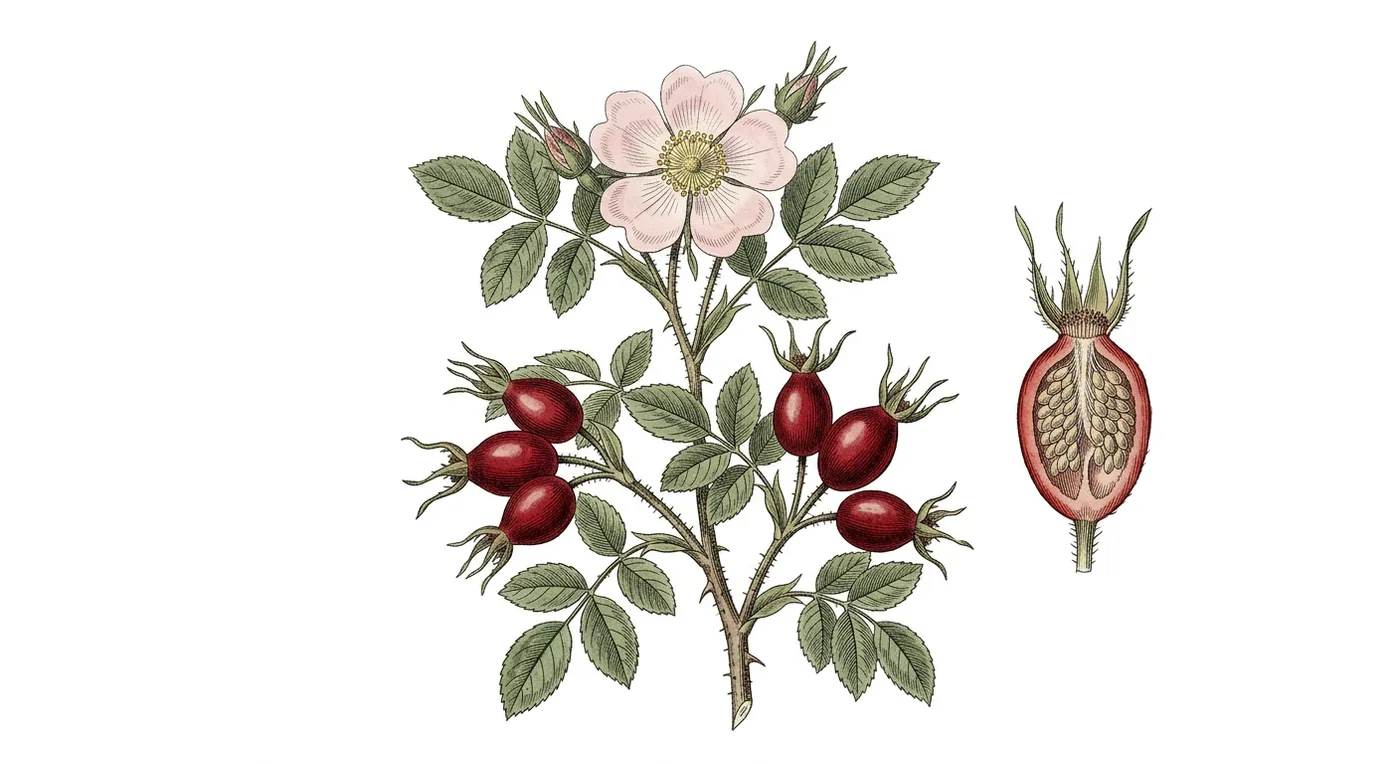
Rosehip seed oil is a light, fast-absorbing vegetable oil pressed from the seeds of wild roses. It is commonly prized in skincare for its unsaturated fatty-acid profile, carotenoids, and small amounts of vitamin A precursors, which give it a thinner feel than heavier vegetable oils and a pale orange tint.
Expectations for rosehip oil range from sensible—smoother, less dry skin—to optimistic—fading scars and lines. The evidence behind those claims is mixed: there is credible preclinical work and a few small human studies, but much of the human data tests multi-ingredient products or oral rosehip preparations rather than the plain topical oil.1,2,3,4

What’s actually in the bottle
Chemically, rosehip preparations contain unsaturated fatty acids and a range of phytonutrients such as carotenoids and vitamins; extraction methods and species affect polyphenol yields. Studies optimizing extraction report that solvent, temperature and time determine how many phenolics you get from Rosa canina fruit and seed preparations, so not all rosehip extracts are the same.5
Reviews of rosehip species note measurable vitamin C and other antioxidants in several Rosa species and draw a mechanistic link between lipophilic constituents and antioxidant or anti-inflammatory activity, which helps explain why rosehip material is of interest in cosmetic and dermatological formulations.2,6
Dryness, the skin barrier and inflammation: the strongest case
The clearest, best-supported use for rosehip in topical care is as an emollient and mild barrier-support oil. In a small human experiment that compared several oils on healthy volunteers, topical rosehip produced the largest short-term increase in skin hydration among the oils tested.7
The clearest, best-supported use for rosehip in topical care is as an emollient and mild barrier-support oil.
Beyond simple moisturization, several preclinical studies show anti-inflammatory and wound‑healing activity. In rodents and cell cultures, rosehip oil or extract stimulated fibroblast proliferation, increased collagen deposition, reduced inflammatory-cell infiltrates and thickened epithelium in induced wounds or ulcer models—mechanisms that could plausibly speed repair of damaged skin.8,9
Narrative reviews that examine plant oils generally also list rosehip oil among botanicals with anti-inflammatory or barrier-repair potential, but these are summaries of varied lab and animal work rather than pooled human trials.6,10
Scars, fine lines and dark spots: small human trials and mixed results

There is modest clinical interest in rosehip for scar management, but the human evidence is limited and often hard to interpret. A recent review of wound- and scar-related studies concluded that there are only a couple of human clinical trials and that while some topical formulations containing rosehip may reduce scar size and redness, the quality and quantity of data are insufficient to make firm recommendations.1
Where human trials exist, many test combination products or different rosehip preparations rather than straight oil. For example, a randomized controlled trial of an anti–stretch‑mark cream that included rosehip oil alongside other active ingredients showed a benefit versus a vehicle for preventing new striae in women without prior marks, but the formulation combined rosehip with multiple actives, so the contribution of rosehip itself is uncertain.3
Separately, oral rosehip powder has been studied for aging-related skin parameters and produced some favorable signals for wrinkles and moisture in a small randomized trial, but oral and topical routes are not equivalent, and that study used a powdered seed-and-shell product rather than a topical oil.4
In short: lab and animal science provide mechanisms (anti-inflammatory, pro‑collagen) that make scar and aging claims plausible, but human topical data specific to plain rosehip oil are sparse and often confounded by other actives.1,3,4,8
human topical data specific to plain rosehip oil are sparse and often confounded by other actives.

Who should be cautious
If your skin is dry, rosehip oil is among the lighter, more absorbent plant oils and may improve short-term hydration; that is supported by a small human test and several reviews of plant oils.7,10
If you are acne‑prone, the picture is muddier. Some reviews highlight antimicrobial activity of rosehip extracts against common skin bacteria, which might sound helpful, but those are preclinical findings and do not demonstrate that topical rosehip oil prevents or reduces acne in people. Oils can also feel heavy or increase oiliness in some complexions, so patch-testing is sensible.6
Oxidation and rancidity are practical worries. Rosehip oil is relatively unsaturated, which helps it carry antioxidant compounds but also makes it more prone to oxidation than more saturated mineral oils. Laboratory formulation work shows that nanoencapsulation or protected formulations can reduce UV‑induced oxidation of the oil, but standard loose oil in a clear bottle will age and lose potency over time.7,11
Finally, many human trials of rosehip in skin conditions test multi‑ingredient lotions or oral preparations, so allergic or irritant reactions reported in those trials cannot be attributed to rosehip alone; if you have sensitive skin or a history of botanical allergies, consider consulting a dermatologist before adding new botanical actives.3,4,12
How to buy and use it
If you want to try a face oil, look for cold‑pressed, seed‑derived rosehip oil in an opaque or dark glass bottle and store it cool and out of direct light; these are simple steps to slow oxidation. Consider a small bottle and monitor smell and color—the oil darkens and smells off when it oxidizes.
For dry or combination skin, rosehip oil can be used as an emollient layer at night or blended sparingly into a moisturizer; if you are acne‑prone, use a patch test or trial a few nights to watch for breakouts. If you are treating scars, stretch marks or pigmentation, expect modest, gradual changes at best and know the best clinical evidence for those outcomes comes from small, mixed trials rather than high‑quality, replicated studies specifically of plain topical oil.1,3
If you are considering rosehip for a medical skin problem—persistent eczema, infected wounds, problematic scarring, or severe acne—see a dermatologist. Clinical decisions for those conditions should be based on dermatological assessment and well‑established treatments; the rosehip literature supplements that knowledge but is not a substitute for specialist care.1,9,12
In the Botanical Index
Sources
- Rosehip extract and wound healing: A review. — Belkhelladi M, Bougrine A. · Journal of cosmetic dermatology · 2024
- A systematic review on the Rosa canina effect and efficacy profiles. — Chrubasik C, Roufogalis BD, Müller-Ladner U, Chrubasik S. · Phytotherapy research : PTR · 2008
- Use of a specific anti-stretch mark cream for preventing or reducing the severity of striae gravidarum. Randomized, double-blind, controlled trial. — García Hernández JÁ, Madera González D, Padilla Castillo M, Figueras Falcón T. · International journal of cosmetic science · 2013
- The effectiveness of a standardized rose hip powder, containing seeds and shells of Rosa canina, on cell longevity, skin wrinkles, moisture, and elasticity. — Phetcharat L, Wongsuphasawat K, Winther K. · Clinical interventions in aging · 2015
- Optimisation of ultrasound-assisted extraction of rosehip (Rosa canina L.) with response surface methodology. — Ilbay Z, Sahin S, Kırbaşlar Sİ. · Journal of the science of food and agriculture · 2013
- Unveiling the mechanisms for the development of rosehip-based dermatological products: an updated review. — Oargă Porumb DP, Cornea-Cipcigan M, Cordea MI. · Frontiers in pharmacology · 2024
- In Vitro and In Vivo Characteristics of Olive Oil as Excipient for Topical Administration. — Rodríguez-Torrado M, Kara A, Torrado S, Romero A, Juberías A, Torrado JJ, Serrano DR. · Pharmaceutics · 2022
- The Efficacy of Rosehip Oil Emulsion as a Pro-Healing Herbal Medicine for the Treatment of Induced Mucosal Ulcer (Cell Culture and Experimental Study). — Dewedar OAM, Habba DA, Zaki HA, Elamin EA, Ibrahim AA, Ahmed OE. · Oral health & preventive dentistry · 2025
- Investigating the effect of a herbal cream containing rose essence in an animal model of eczema. — Malayeri AR, Salimi A, Iraji F, Sabbagh S, Shakerian N, Khaledi M. · Avicenna journal of phytomedicine · 2025
- Anti-Inflammatory and Skin Barrier Repair Effects of Topical Application of Some Plant Oils. — Lin TK, Zhong L, Santiago JL. · International journal of molecular sciences · 2017
- Nanoencapsulation of Rose-Hip Oil Prevents Oil Oxidation and Allows Obtainment of Gel and Film Topical Formulations. — Contri RV, Kulkamp-Guerreiro IC, da Silva SJ, Frank LA, Pohlmann AR, Guterres SS. · AAPS PharmSciTech · 2016
- A randomized controlled trial to compare the effectiveness and safety of adsorbent lotion containing tapioca starch, spent grain wax, Butyrospermum parkii extract, argania spinosa kernel oil, aloe barbadensis, rosehip oil, and allantoin with a low-potency topical corticosteroid in the treatment of intertrigo. — Leeyaphan C, Varothai S, Trakanwittayarak S, Suphatsathienkul P, Pattaravadee S, Matthapan L, Prasong W, Lertrujiwanit K, Supcharoenkul S, Kulthanan K. · Journal of cosmetic dermatology · 2022
Discussion
2 commentsShare experiences, questions and sources. Be kind, and please don't give medical advice. Comments are checked before they appear, and anything that reads like a treatment claim goes to our editors first.
Join the conversation
A free reader account lets you comment and reply to other readers.
horito's mum i like it makes glowing nd smoother relly
horito's mum me to