Evidence Check · Tea tree
Tea tree oil: real antimicrobial, real allergy risk
Laboratory work and small clinical trials support tea tree oil’s antibacterial and antifungal activity, and a recent meta-analysis found topical tea tree reduced acne severity; reviews and formulation studies also warn of local irritation and stability problems. Current evidence is useful but limited, and safety concerns in topical use are repeatedly raised.
Tea tree oil (Melaleuca alternifolia) is one of the better‑studied essential oils for skin: laboratory studies show activity against acne‑related bacteria and dermatophyte fungi, and pooled clinical data indicate modest benefit for acne. At the same time, reviews and formulation papers repeatedly note local skin reactions, instability, and other safety concerns that matter when the oil is used topically.1,2,3,4,5,6

What the trials and reviews say about acne and fungal infections
A 2026 systematic review and meta‑analysis of clinical studies found topical tea tree oil was associated with a reduction in acne severity when compared with controls, pooling seven studies and 445 patients and reporting an overall favourable odds ratio for improvement.4
Multiple narrative and scoping reviews reach similar, cautiously positive conclusions: tea tree oil is the most studied essential oil for acne, and clinical gel studies have shown lesion reduction and fewer adverse reactions than some conventional comparators, but reviewers stress that trial numbers are small and methods heterogeneous.7,8,9
The antibacterial and antifungal activity underlying those clinical signals is well documented in vitro. Tea tree oil inhibits Cutibacterium acnes in culture, with reported MICs in the low tenths of a percent, and it suppresses dermatophyte growth in vitro at similarly low concentrations in multiple studies.2,3,10,11
Tea tree oil inhibits Cutibacterium acnes in culture, with reported MICs in the low tenths of a percent
For fungal foot and nail infections, reviews describe a modest benefit in randomized trials but note the evidence base is small and trial quality variable; much of the stronger support so far comes from laboratory and formulation studies rather than large, high‑quality clinical trials.2,12,13
Why concentration and formulation matter
Laboratory MICs for tea tree oil against acne and fungal pathogens are low—examples include MICs around 0.16–0.25% against Cutibacterium acnes and values near 0.4% against some Trichophyton isolates—yet these numbers do not translate directly into safe topical use of neat oil.2,3,10
Many investigators therefore test tea tree oil inside formulated systems: microemulgels, hydrogels, encapsulated membranes and cellulose films have been developed to control release, improve stability, and reduce skin irritation while maintaining antimicrobial effect.1,10,13,14
Clinical trial formulations vary. Some randomized studies combine tea tree oil with other actives or use nano‑ or micro‑delivery platforms; those combinations can improve efficacy or tolerability, but they do not tell you how pure, undiluted oil behaves on skin.15,16,17
Laboratory and formulation papers also point out that higher concentrations and undiluted use are associated with greater skin irritation in experimental systems, so concentration and vehicle influence both effectiveness and risk.1,6,14
Oxidation, irritation and allergic risk
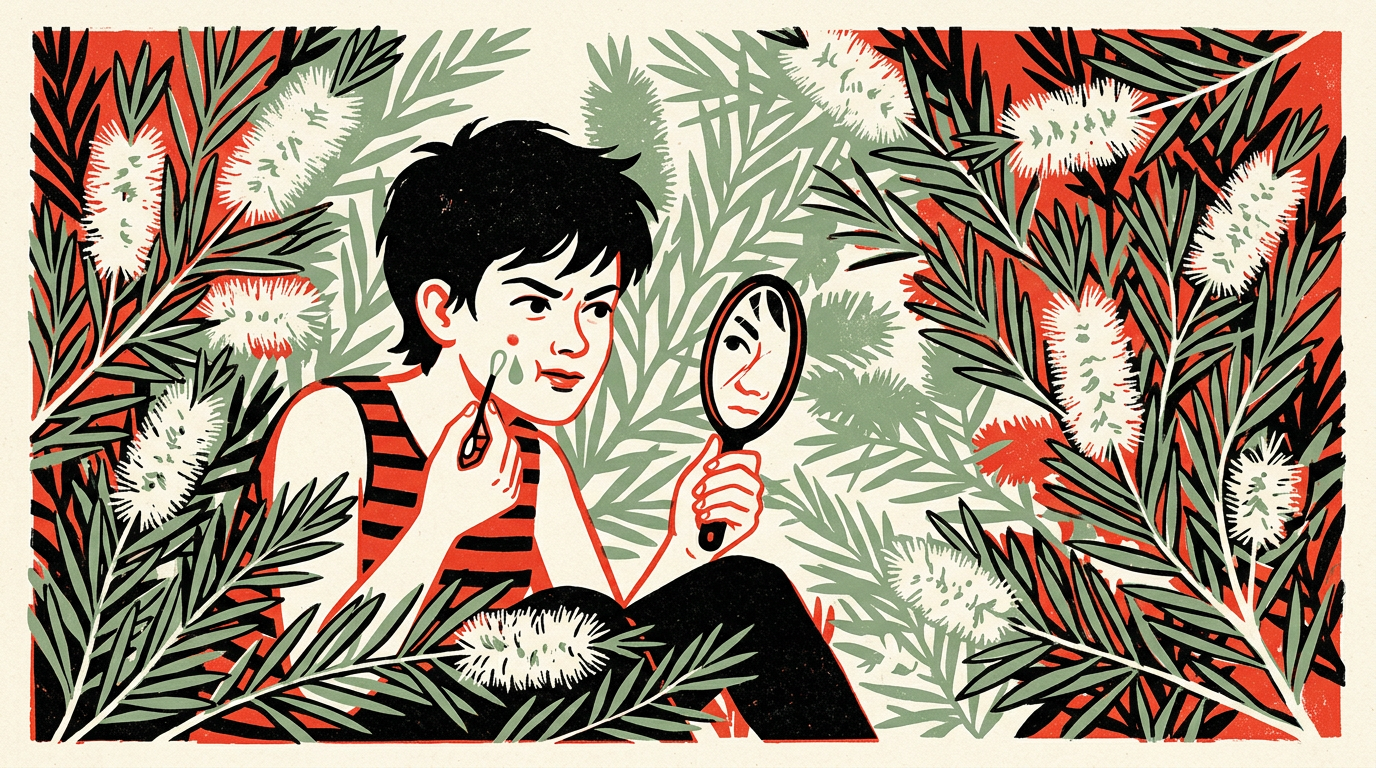
Formulation studies note that tea tree oil is volatile and susceptible to oxidative change; that instability is one reason manufacturers look to encapsulation and other delivery systems to preserve activity and limit degradation.1,14
Clinical reviews and systematic reviews report local adverse events in trials—mostly mild and localized—but they also flag safety concerns including irritation and allergic reactions in some users, and they underline the need for better safety data across products and concentrations.4,5,6,18
Because essential oils change chemically as they age or when exposed to air and light, products that are improperly stored or old may differ from fresh preparations; reviewers recommend attention to stability in both research and product design.1,6,14
Practical safety and clinical takeaways
What the evidence supports: laboratory and formulation studies consistently show antimicrobial activity, and a meta‑analysis of small clinical trials found topical tea tree reduced acne severity compared with controls; these data justify continued research and cautious clinical use in selected topical formulations.1,3,4,10
What it does not support: the existing clinical evidence is limited in size and scope, and many studies use formulated products rather than neat oil, so you cannot assume that raw, undiluted tea tree oil is safe or more effective than a properly formulated preparation.4,14,15,16
you cannot assume that raw, undiluted tea tree oil is safe
Safety notes: trials and reviews repeatedly report local skin reactions and note stability problems; those are the main practical risks to users. If topical use is considered, formulations designed to control concentration and limit oxidation are preferable in the trial literature to undiluted oil.1,5,6,14
For anything beyond mild cosmetic concerns—new, spreading, painful, or persistent lesions—seek assessment by a dermatologist or other clinician rather than relying on over‑the‑counter essential‑oil preparations.
In the Botanical Index
Sources
- Hydrolyzed collagen-modified bacterial cellulose loaded with tea tree oil for antibacterial activity against acne-associated bacteria. — Salawudeen T, Jomrit J, Kaewpradit S, Nokkaew N, Jantarat C. · RSC advances · 2026
- Antifungal Activity of Tea Tree (Melaleuca alternifolia Cheel) Essential Oils against the Main Onychomycosis-Causing Dermatophytes. — Mingorance Álvarez E, Villar Rodríguez J, López Ripado O, Mayordomo R. · Journal of fungi (Basel, Switzerland) · 2024
- Evaluation of tea tree oil physicochemical features and its antimicrobial activity against Cutibacterium acnes (Propionibacterium acnes) ATCC 6919 — Ossa-Tabares JC, Llanos CJ, García AM. · Biomedica : revista del Instituto Nacional de Salud · 2020
- Efficacy and Safety of Melaleuca alternifolia (Tea Tree) Oil for Acne-A Systematic Review and Meta-Analysis. — Ye Y, Lim JJ, Huang Z, Chew FT. · Phytotherapy research : PTR · 2026
- Efficacy and safety of Melaleuca alternifolia (tea tree) oil for human health-A systematic review of randomized controlled trials. — Kairey L, Agnew T, Bowles EJ, Barkla BJ, Wardle J, Lauche R. · Frontiers in pharmacology · 2023
- Antimicrobial and Anti-Infective Potential of Herbal Creams in Dermatology: Efficacy, Safety, and Challenges in Skin Infection Management. — Brar GS, Nandy SK, Sharma A, Siddiqui AJ, Sharma L. · Infection and drug resistance · 2025
- Tea Tree Oil: Properties and the Therapeutic Approach to Acne-A Review. — Nascimento T, Gomes D, Simões R, da Graça Miguel M. · Antioxidants (Basel, Switzerland) · 2023
- The Therapeutic Potential of Essential Oils in Managing Inflammatory Skin Conditions: A Scoping Review. — Dontje AEWK, Schuiling-Veninga CCM, van Hunsel FPAM, Ekhart C, Demirci F, Woerdenbag HJ. · Pharmaceuticals (Basel, Switzerland) · 2024
- Evaluating efficacy, safety, and innovation in skin care applications of essential oils: a systematic review. — Pezantes-Orellana C, German Bermúdez F, Montalvo J, Packer T, Orellana-Manzano A. · Frontiers in medicine · 2025
- Formulation, Optimization, and Comprehensive Characterization of Topical Essential Oil-Loaded Anti-Acne Microemulgels. — Kola-Mustapha AT, Raji MA, Alzahrani YA, Binsaeed NH, Adam DR, Shameh RA, Garaween NM, Garaween G. · Gels (Basel, Switzerland) · 2025
- Solubilization in vitro of tea tree oil and first results of antifungal effect in onychomycosis. — Marcos-Tejedor F, González-García P, Mayordomo R. · Enfermedades infecciosas y microbiologia clinica (English ed.) · 2021
- A Review of The Efficacy of Complementary and Alternative Medicines in Managing Dermatologic Infectious Diseases. — Ufomadu P, Gill BJ, Shimizu I, Orengo I, Rosen T. · The Journal of clinical and aesthetic dermatology · 2025
- Evaluation of cellulose based films comprising tea tree oil against dermatophytes and yeasts. — Laffleur F, Ataii M, Nagler M. · European journal of pharmaceutical sciences : official journal of the European Federation for Pharmaceutical Sciences · 2021
- Chitosan membrane tailored for topical acne treatment by incorporating Pickering encapsulated tea tree oil based on organosilane-modified palygorskite. — Jiang C, Cui H, Tan P, Huang Q, Liu Q, Dong J, Tang Y. · International journal of biological macromolecules · 2025
- A topical gel of tea tree oil nanoemulsion containing adapalene versus adapalene marketed gel in patients with acne vulgaris: a randomized clinical trial. — Najafi-Taher R, Jafarzadeh Kohneloo A, Eslami Farsani V, Mehdizade Rayeni N, Moghimi HR, Ehsani A, Amani A. · Archives of dermatological research · 2022
- Azelaic acid and Melaleuca alternifolia essential oil co-loaded vesicular carrier for combinational therapy of acne. — Bisht A, Hemrajani C, Upadhyay N, Nidhi P, Rolta R, Rathore C, Gupta G, Dua K, Chellappan DK, Dev K, Sourirajan A, Aljabali AA, Bakshi HA, Negi P, Tambuwala MM. · Therapeutic delivery · 2022
- Hydrogel composite containing azelaic acid and tea tree essential oil as a therapeutic strategy for Propionibacterium and testosterone-induced acne. — Bisht A, Hemrajani C, Rathore C, Dhiman T, Rolta R, Upadhyay N, Nidhi P, Gupta G, Dua K, Chellappan DK, Dev K, Sourirajan A, Chakraborty A, Aljabali AAA, Bakshi HA, Negi P, Tambuwala MM. · Drug delivery and translational research · 2022
- Herbal Creams in Dermatology: Efficacy, Safety, Formulation, and Regulatory Considerations. — Kamal R, Chauhan A, Singh TG, Dhiman S, Awasthi A. · Current pharmaceutical design · 2026
Discussion
0 commentsShare experiences, questions and sources. Be kind, and please don't give medical advice. Comments are checked before they appear, and anything that reads like a treatment claim goes to our editors first.
Join the conversation
A free reader account lets you comment and reply to other readers.
No comments yet. Start the discussion.